All posts by islam

Resistance leaders hail Palestinians’ struggle

On Tuesday, the Resistance leaders, Ayatollah Seyyed Ali Khamenei and Sayyid Hassan Nasrallah, spoke out against the barbarity of the Israeli regime and supported the resistance of the Palestinian fighters, trying to attract the attention of the global community to the Palestinian question.

In his meeting with the university students late on Tuesday, Leader of the Islamic Revolution Ayatollah Khamenei touched on various issues going on in the world, but he dedicated the last part of his speech to international Quds Day, which falls on April 29 this year.

Referring to the forthcoming Quds Day, the Leader of the Islamic Revolution considered this year’s Quds Day different from previous years and said, “This year, Quds Day is different from other years. Palestinians have made great sacrifices both last Ramadan and this Ramadan. The Zionist regime is committing the worst crimes. They commit every crime they want, and the U.S. and Europe support it.”

Ayatollah Khamenei called the Palestinian people powerful while oppressed, and praised the struggle of the Palestinian youth who do not allow the Palestinian cause to be forgotten.

He added, “Quds Day is a good opportunity to express sympathy and solidarity with the oppressed Palestinian people and give them a morale-boosting.”

He also strongly criticized the silence of some Islamic countries on the issue of Palestine, noting, “Unfortunately, Islamic states have behaved very badly (in this regard) and are not even willing to talk about the issue of Palestine. Some of them think that the way to help Palestine is to establish relations with the Zionists, while this is a grave mistake.”

Referring to the great mistake made by the Egyptian government more than 40 years ago that established relations with the Zionists, the Leader of the Islamic Revolution asked, “Does the Islamic world want to repeat the same mistake of Anwar Sadat?”

He then critiqued those countries that copied the same strategy of Sadat, saying, “Normalization with the Zionist regime will harm the copycats and the Palestinians.”

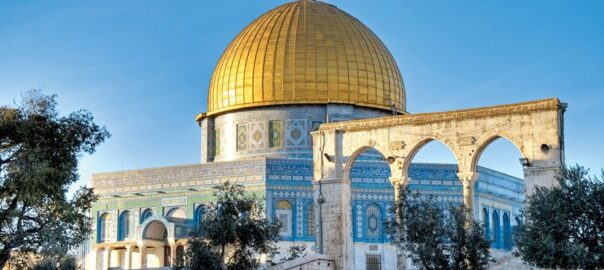
Emphasizing that establishing relations with the Zionist regime will not be of any use, Ayatollah Khamenei said, “We hope that with God’s grace, the conclusion of resistance in Palestine will be a happy ending, and that the Palestinians regain domination of their land and Al-Aqsa Mosque soon.”

On the same day, Hezbollah’s Secretary-General Sayyid Hassan Nasrallah gave a key speech about the resilience of the Palestinian fighters.

Nasrallah said, “The most important reason for what we are exposed to in Lebanon, as well as to what countries and resistance movements in our region are subjected to, is everyone who belongs to this movement (of resistance), to this axis, to this idea, to this origin, to this goal, faced siege and sanctions and restrictions. We are subjected to these sanctions at the international, regional and domestic levels, and the sanctions’ main goal is to abandon Quds, Palestine, the logic of resistance, and the culture of resistance.”

Speaking at the “Al-Quds Forum 2022 – the Equation,” Nasrallah said that war in Quds means a “regional war.”

“Today, we’re standing on the verge of great and final victory,” he said, declaring that the axis of resistance is prepared to make whatever sacrifices that are necessary to realize the prospect.

“Quds is our model and goal,” he said and urged that the axis of resistance be rather called “the al-Quds axis” due to the centrality of the holy city to unity among the axis’ members.

Nasrallah, meanwhile, warned that the global arrogance’s strategy on the issue of Palestine rested on “killing time” so the Palestinian and other Muslim nations end up forgetting and despairing of the Palestinian cause.

“However, what is actually taking place is contrary to their desire,” Nasrallah said.

He then concluded his speech by saying that the resistance movement will continue its path regardless of how great the sacrifices, threats, difficulties and dangers will be.

“God willing, we will continue together hand in hand and shoulder to shoulder. All the resistance factions, all the resistance movements, all the peoples of the resistance, and all the countries of the resistance will break all restrictions and nullify all conspiracies. All the daggers that try to stab in our backs and in our chests will fall. Our real battle that will create complete freedom for the holy Quds, and Quds will remain the title, the goal, and the foundation of the axis,” he stressed.

Similarly, Ismail Haniyeh, chairman of the Hamas Political Bureau stated that resistance was the Palestinian nation’s preferred option, citing effective Palestinian operations across the occupied West Bank since the start of Ramadan.

As a result, he argued, issues like the occupation and the right of Palestinians to return to their homeland “cannot be handled at the negotiating table.”

Realizing this, the Zionist regime began restoring relations with several regional powers in order to “legitimize its existence and its objectives for the destruction of the Palestinian cause,” Haniyeh remarked.

According to Haniyeh, Tel Aviv was also attempting to exploit the situation in Ukraine as a smokescreen for its intentions for al-Quds and the al-Aqsa Mosque.

“However, all of the regime’s efforts to manipulate the Palestinian nation have failed,” he said, adding that “our nation does not tolerate distortion of the al-Aqsa Mosque’s identity and the historical realities that apply to it.”

The Palestinian conflict has been ongoing on since World War II, but the global community has chosen to be silent despite flagrant violations of Palestinians’ basic rights. But now the world is turning its attention to Palestine.

In a significant development, UN human rights experts called on the international community to take immediate and effective steps to protect and sustain the six Palestinian civil society groups that were designated as “terrorist organizations” by the Israeli regime in October 2021.

In a press release by the Office of the High Commissioner of the United Nations Human Right body, the UN experts dubbed the Israelis’ move to designate civil society groups as terrorist organizations as a “disturbing designation.”

“Israel’s disturbing designation of these organizations as ‘terrorist organizations’ has not been accompanied by any public concrete and credible evidence,” said the human rights experts. “We note that the information presented by Israel has also failed to convince a number of governments and international organizations that have traditionally provided funding for the indispensable work of these six organizations.”
Recently, a four-year study by Amnesty International partly revealed the true color of the Israeli regime and called on the international organizations to bring the Israeli officials to justice. But the million-dollar question is, will the world listen?

Amnesty International’s rigorous study and legal analysis, conducted in cooperation with other experts, shows that Israel pushes ahead with its malicious behaviors toward Palestinians through enacting laws and practices that ensure continued harsh discrimination.

Specific unlawful acts performed under a totalitarian ideology and supremacy with the goal of preserving it constitute the crime against humanity of apartheid, according to international criminal law. The Apartheid Convention and the Rome Statute define these crimes as unlawful killing, torture, forcible transfer, and denial of basic rights and freedoms.

Massive seizure of Palestinian land and property, unlawful killings, forcible transfer, severe movement restrictions, and the denial of nationality and citizenship to Palestinians are all components of a system that amounts to apartheid under international law, according to the comprehensive report titled “Israel’s Apartheid against Palestinians: Cruel System of Domination and Crime against Humanity.” This system is upheld by transgressions that Amnesty International determined to be apartheid as a crime against humanity, as defined by the Rome Statute and the Apartheid Convention.

Amnesty International has urged the International Criminal Court (ICC) to include apartheid as a crime in its ongoing investigation in the OPT, and all governments to use universal jurisdiction to prosecute perpetrators of apartheid crimes.

For committing the crime of apartheid against Palestinians, Israeli authorities must be held accountable.

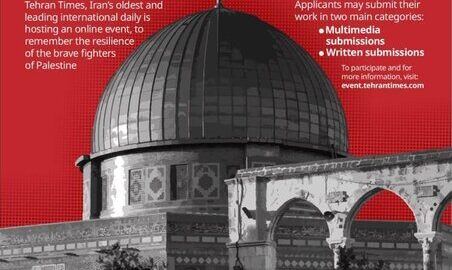
In this regard, as Iran’s leading international daily, the Tehran Times will host its first online event, dubbed “Remember Palestine.” The event will focus on various aspects of the Palestinian cause as the Islamic world’s number one issue.

The event is aimed to commemorate the chivalrous Palestinian fighters, as well as the free-spirited people around the world who take the issue of injustice done to the Palestinians seriously. It also explores various aspects of Intifadas, as well as the issue of human rights violations in Palestine.

It will also promote awareness on the plight of Palestinians whose land has been under Israeli occupation immediately after World War II. “Remember Palestine” will be held on Friday, April 29, which coincides with international Quds Day, and will end on May 15, known as Nakba Day (Day of Catastrophe).

To register and know more about event categories and submission topics, visit event.tehrantimes.com. /T.T/
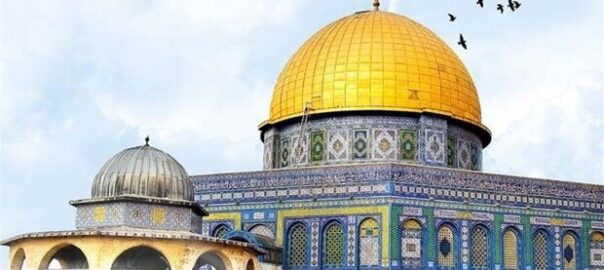
Different Quds Day

After a two years hiatus in marking the International Quds Day due to Covid-19 restrictions, millions of Muslims in Iran and other countries are gearing up for condemning Israel’s occupation of Palestinian territories.

International Quds Day is marked on the last Friday of the holy month of Ramadan every year. The occasion was designated at the initiative of Imam Khomeini. This year’s Quds Day rolls around on 29 April.

Massive preparations are underway across Iran to magnificently stage processions and online events. Mohammad Hossein Mousa Pour, chairman of the Islamic Advocacy Council, said on Wednesday that the Quds Day processions will be held in Tehran and 900 cities and villages around the country.

“This year, we are going to witness the holding of popular processions across the country after two years,” Mousa Pour, a cleric, said. “The Quds Intifada Commission was formed and it reviewed the strategies, plans, and slogans. Now, there is coordination and convergence for implementing the programs inside and outside the country,” he said.

According to the chairman, who is in charge of planning and coordinating the Quds Day activities, Commander of the Islamic Revolution Guards Corps (IRGC) General Hossein Salami will deliver a speech at the University of Tehran, where the demonstrators will gather for the Friday Prayer. Other Iranian officials are expected to deliver speeches on the occasion.

Also, Iranian Foreign Minister Hossein Amir Abdollahian will take part in an online event on Palestine along with Ali Akbar Velayati, an advisor to the Leader of the Islamic Revolution of Iran Ayatollah Seyed Ali Khamenei on international relations. The event, promoted as the biggest online International Quds Day ceremony, is dubbed “liberating Quds as the capital of Palestine.”

Earlier on Tuesday, Ayatollah Khamenei hailed this year’s Quds Days as being different from previous years.
Addressing a number of university students on Tuesday afternoon, the Leader said, “This year’s Quds Day is different from other years. The Palestinians have been making great sacrifices both during last year’s and this year’s Ramadan. The Zionist regime is committing the worst crimes, and the US and Europe are supporting them.”

He added, “Palestine is both oppressed and powerful; it’s an oppressed power. I said the same about Iran many years ago. Palestine is truly strong today. The Palestinian youth do not allow the question of Palestine to be forgotten and they’re standing up in opposition to the enemy’s crimes.”

Lebanese newspaper Al-Akhbar has said that the resistance of the Palestinians has become a source of concern for Israel given the coincidence of the Quds Day and the Day of Nakba, which falls on May 15.

“Despite the relative calm currently in force in the occupied Palestinian territories, it does not seem that the escalation will be delayed before it rears its head again. Israel is waiting for two occasions that constitute an annual date for Palestinian activities in the face of the occupation, namely Quds Day and the Nakba commemoration,” the newspaper said.

It described the security situation in Palestine as “fragile to the extent that any operational mistake could push towards a wide confrontation.” /T.T/

Tehran Times to host online event on Palestine

Iranian newspaper Tehran Times is going to hold an online event titled Remember Palestine” to raise awareness of the plight of Palestinians in the hands of the usurping Israeli regime.

The event is divided into two categories with each having its own sub-categories including posters, cartoons, video comments, and blogging which are supposed to be posted by would-be participants. / MNA/

Ramsar Convention Museum to be established

The Ramsar Convention Museum will be launched in the northern city of Ramsar with the participation of the private sector, Shahram Fadakar, the director of the Ramsar regional center for education and research in Central and West Asia, has stated.

“This museum will be located in a part of the Mazandaran’s Ramsar museum palace and will include published sources and documents along with the approvals of the Ramsar Convention, historical images, and other items related to this convention that is exposed to the public and environmental enthusiasts in particular.

The Convention on Wetlands is an intergovernmental treaty that provides the framework for the conservation and wise use of wetlands and their resources. Also, in order to introduce the role of wetlands, part of the museum’s untouched environment will be turned into an artificial wetland so that visitors at different levels are informed about the ecological functions of the wetlands,” he explained.

The Convention on Wetlands is an intergovernmental treaty that provides the framework for the conservation and wise use of wetlands and their resources.

It was adopted in the Iranian city of Ramsar in 1971 and came into force in 1975. Since then, almost 90% of UN member states, from all the world’s geographic regions, have acceded to becoming “Contracting Parties”.

Wetlands are indispensable for the countless benefits or “ecosystem services” that they provide humanity, ranging from freshwater supply, food and building materials, and biodiversity, to flood control, groundwater recharge, and climate change mitigation.

Yet study after study demonstrates that wetland area and quality continue to decline in most regions of the world. As a result, the ecosystem services that wetlands provide to people are compromised.

Managing wetlands is a global challenge and the Convention presently counts 172 countries as Contracting Parties, which recognize the value of having one international treaty dedicated to a single ecosystem.

The Convention uses a broad definition of wetlands. This includes all lakes and rivers, underground aquifers, swamps and marshes, wet grasslands, peatlands, oases, estuaries, deltas, tidal flats, mangroves, and other coastal areas, coral reefs, and all human-made sites such as fish ponds, rice paddies, reservoirs, and salt pans.

In Iran, 141 wetlands with ecological value with an area of over 3 million hectares have been identified, of which 25 wetlands are designated as wetlands of international importance (registered in the Ramsar Convention) covering more than 1.4 million hectares and four sites are biosphere reserves. //T.T/

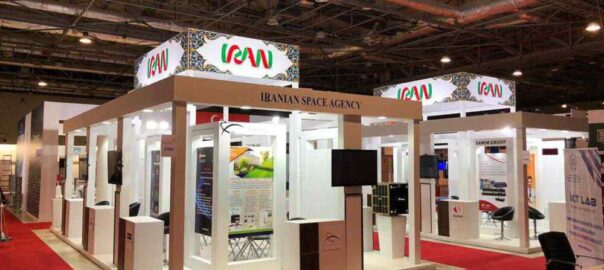
Iranian knowledge-based products to develop markets in Russia, Armenia

The Innovation and Prosperity Fund has organized two events to expand the international markets for Iranian knowledge-based products in Russia and Armenia.

In this regard, fifteen knowledge-based firms will attend the International Specialized Exhibition of Medical and Health Equipment of Iran with the support of the Innovation and Prosperity Fund in Yerevan, the capital of Armenia, from June 10 to 12.

In this exhibition, knowledge-based companies active in the fields of medical equipment will showcase their products, including operating room and emergency equipment, medical consumables, laboratory, and dental equipment, orthopedic supplies and products, hospital equipment and facilities, radiology and sonography equipment, diagnostic informatics products, nanotechnology, and medical innovations.

Five houses of innovation and technology have so far been inaugurated in Kenya, China, Russia, Syria, and Turkey to boost export of knowledge-based products. Moreover, the 29th exhibition of ‘Sundays for Exports’ was held at the Innovation and Prosperity Fund with the participation of domestic knowledge-based companies and the Russian business delegation.

In this technological event, Iranian knowledge-based companies exhibited various products and discussed with Russian marketers the issue of exporting their products.

In the previous 28 events, 15 companies succeeded to export their products to other countries.

Exporting technological products of Iranian knowledge-based companies is one of the important and key programs of the vice presidency for science and technology, and in this regard, five houses of innovation and technology were inaugurated in Kenya, China, Russia, Syria, and Turkey.

It is also planned to establish two innovation centers in Iraq and Armenia over the next six months.

Knowledge-based companies

Today, the country’s knowledge-based ecosystem accounts for more than 3 percent of GDP. And the figure is projected to reach 5 percent, however, the main goal is to step toward a 10 percent share in GDP, Sattari told Fars on February 13.

The share of knowledge-based companies in the country’s economy has exceeded 9 quadrillion rials (about $34 billion), and since 2019, it has experienced a growth of more than 450 percent, he stated.

There are currently 6,263 knowledge-based companies operating in the country, offering advanced products and services in various fields of technology to domestic and foreign markets, and some of them have entered international markets, Siavash Maleki, deputy head of the Fund, stated.

The fields of aircraft maintenance, steel, pharmaceuticals, medical equipment, oil, and gas are among the sectors that researchers in technology companies have engaged in, leading to import reduction.  /T.T/

Kermanshah preparing to get Taq-e Bostan on UNESCO list

The tourism chief of Kermanshah province on Sunday said his directorate is preparing to apply to UNESCO for the listing of Taq-e Bostan on the World Heritage list.

“We aim to pave the way for the inscription of Taq-e Bostan on the UNESCO World Heritage list within the next 18 months,” Jabbar Gohari said.

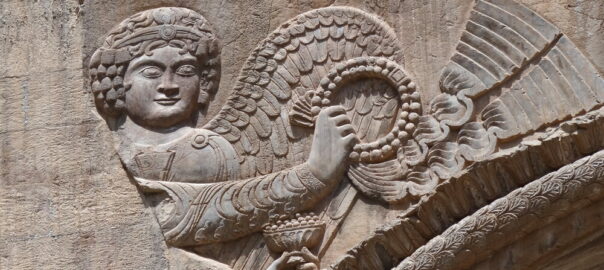
Taq-e Bostan consists of a series of properties from prehistoric to historical periods such as Morad-Hassel Tepe, an ancient village, a Parthian graveyard, and Sassanid hunting ground. However, the most significant property of the complex belongs to the Sassanid one which comprises two porticos (large and small Ivans) as well as outstanding bas-reliefs from the same period.

“During the past years, illegal constructions and exploitations have been carried out near Taq-e Bostan. In this regard, we expect the regulatory bodies, including the Kermanshah judiciary, to solve this problem as soon as possible.”

Moreover, we have consulted with the visiting UNESCO evaluators and experts in order to come up with a clear solution, the official added.

According to Lonely Planet, the site’s extraordinary Sassanian bas-reliefs of ancient victorious kings, which are inscribed into the base of a towering cliff, divide opinions. Some travelers feel disappointed by the Taq-e Bustan experience, as there’s a relatively high admission price for a few stone carvings and a duck pond, both of which are viewed easily from outside the fence. For Iranians, a visit is a joyous celebration of their incredible Persian heritage. Whether you immerse yourself or crank up the zoom lens is up to you.

Taq-e Bustan was originally the site of a Parthian royal hunting garden, but the Sassanians later added their own regal stamp. Its biggest alcove features elephant-mounted hunting scenes on the sidewalls and highlights the coronation of Khosrow II (r 590–628), beneath which the king rides off in full armor and chain mail (half a millennium before the European Black Prince made it fashionable).

The second niche shows kings Shapur III and his Roman-stomping grandfather Shapur II. To the right of the niches is a fine tableau again showing Shapur II (r 379–383), in which he is depicted trampling over the Roman emperor Julian the Apostate (whom he defeated in 363) and receiving a crown of blessings from the Zoroastrian god Mithras.

It is said that late afternoon is the best time to visit, as the cliff turns a brilliant orange in the setting sun, which then dies poetically on the far side of the duck pond. The surrounding open-air restaurants rock out till late in the evening, and the carvings are warmly floodlit. The site is 10km north of Kermanshah’s city center.

Kermanshah, formerly Bakhtaran, the capital of Kermanshah province, was founded in the 4th century CE by Bahram IV of the Sasanian dynasty.

Conquered by the Arabs in 640, the town was called Qirmasin (Qirmashin). Under the Seljuk rule in the 11th century, it was the chief town of Kordestan. The Safavids (ruled 1501–1736) fortified the town, and the Qajars repulsed an attack by the Turks during Fath Ali Shah’s rule (1797–1834). Occupied by the Turkish army in 1915 during World War I, it was evacuated in 1917. The construction of a road in the 1950s over the age-old Khorasan track added considerably to the importance of the city. / T.T/


Iranian documentary goes to Hungarian, South Korean festivals

Iranian documentary ‘Water, Wind, Dust, Bread’ will take part in Hungarian and South Korean film festivals.

Directed by Mehdi Zamanpour Kiasari, ‘Water, Wind, Dust, Bread’ is slated to be screened at the 32nd edition of the MEDIAWAVE International Film in Hungary and the 10th Seoul Int’l Children’s Film Festival in South Korea.

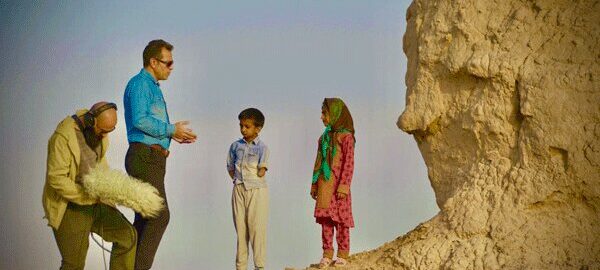
The 25-minute documentary ‘Water, Wind, Dust, Bread’, which took more than a year to produce, is a delicate narrative of the life of two children named ‘Abolfazl’ and ‘Setayesh’ who experience a different life.

The documentary has been previously screened at the 18th edition of ZagrebDox, the International Documentary Film Festival and the 24th edition of the Thessaloniki Documentary Festival in Greece and a special screening section of the 15th Miradasdoc International Film Festival in Spain. /MNA/

Iranian researchers register patent for anti-coronavirus intranasal mask

A team of Iranian researchers has managed to register a worldwide patent for an anti-coronavirus intranasal mask.

The pattern published by the World Intellectual Property on April 7, has been designed and developed by Meisam Akhlaghdoust, Alireza Zali, Atousa Hashemi, Neusha Arang, Fatemehzahra Hashemi, Ilia Mehrizi, and Poorya Davoodi.

Coronaviruses can be transmitted to others through droplets that are spread by coughing or exhaling from the mouth and nose of a Covid-19 infected person.

The most effective way to protect yourself and others is to wear a mask.

Studies show that prolonged wearing of face masks can result in some airway and skin allergies. Regular use of face masks in low-density populated areas or hot environments can be frustrating and the cause of dyspnea.

Lack of recognition in identity, face, and even a smile or various facial expressions can lead to future psychological problems.

Wearing face masks is impossible and difficult in the environments such as hair salons and restaurants where a person has to remove his mask which makes the person more exposed to the virus.

This invention has 5 layers of inhalation and exhalation air filtration which is inserted into the nasal cavities by two spiral cones.

It is interesting to note that the invention has won the silver prize at the First International Invention and Innovation Competition which was held online in Geneva, Switzerland in July 2021. /T.T/

Iran freestyle wrestling team crowned Asian champions

Iran’s national freestyle wrestling team ranked first place in the Asian Wrestling Championships in Mongolia.

Rahman Amouzad, Yunes Emami, Ali Savadkoohi, Amir Hossein Firouzpour, Mohammad Hossein Mohammadian, and Yadollah Mohebi defeated their opponents and grabbed the gold medals for Iran in the 65 kg, 74 kg, 79 kg, 92 kg, 97 kg, 125 kg weight categories respectively at the Asian Wrestling Championships in Ulaanbaatar, Mongolia.

Also, Dariush Hazrat Gholizadeh (61 kg) won a silver medal at the event.

Earlier, the Iranian Greco-Roman wrestling team ranked second in the Asian competitions.

The 2022 Asian Wrestling Championships are the 35th edition of the Asian Wrestling Championships of combined events, and take place from April 19 to 24 in Ulaanbaatar, Mongolia. / MNA/