All posts by islam

Persian leopard spotted in Esfarayen

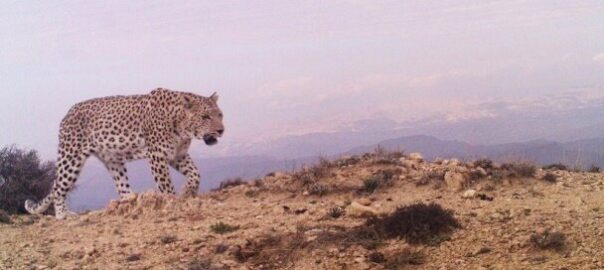
The head of Esfarayen’s department of environment said that a Persian leopard has been spotted in Salouk National Park in North Khorasan Province.

Ali Faraji, the head of Esfarayen’s department of environment said on Sunday that park rangers of the Salouk National Park spotted a Persian leopard and recorded the footage of it during their patrolling.

Since the beginning of the Iranian year [started on March 20, 2022], three leopards have been observed and photographed in these areas, he added.

The Persian leopard is a leopard subspecies native to the Iranian Plateau and surrounding areas encompassing Turkey, the Caucasus, Iran, Turkmenistan, Afghanistan and possibly Pakistan. It is distributed in different ecosystems, and Golestan Natural Park is one of the main habitats of the species in northeast Iran. Since 2016, it has been listed as Endangered on the IUCN Red List, as the wild population is estimated at less than 1000 mature individuals.

Salouk National Park, with an area of 8,231 hectares, consists of fabulous nature, various fauna and plant species, and specific geomorphology. The mountainous topography has made Salouk National Park one of the most varied wildlife habitats. More than 100 animal species have been identified in Salouk National Park.

A large number of Urial, gazelle, Wild goat, leopard, wildcat, and marten are the rare animal species of this area. /MNA/

Iran’s annual petchem export stands at over $15b

Iran exported petrochemical products valued at more than $15 billion in the past Iranian calendar year 1400 (ended on March 20), the managing director of National Petrochemical Company (NPC) announced.

Morteza Shahmirzaei made the remarks in a press conference held on the sidelines of the 26th International Oil, Gas, Refining and Petrochemical Exhibition of Iran (Iran Oil Show 2022) on Monday.

The official said that of the mentioned $15 billion petrchem revenues, over $12.5 billion was injected into the Forex Management Integrated System, locally known as NIMA.

The petrochemical industry plays a crucial role in Iran’s non-oil economy, as the petrochemical export is the second-largest source of revenue for the country after crude oil. Petrochemical exports already constitute nearly 33 percent of the country’s non-oil exports.

The NPC’s managing director further stressed that petrochemical industry is a value and job-creating industry, which has no risk.

The official said that 69 production units (including three service units which provide services such as water, electricity, and steam for the production units) are now active in the petrochemical industry of Iran, which play some significant role in bringing foreign currency for the country.

Annual petchem production capacity reaches 90m tons

Shahmirzaei further announced that the country’s petrochemical production capacity reached 90 million tons in the past year.

He said that the real production is 65 million tons, and the difference between the two figures is due to some reasons, one of them is the overhaul operations of the petrochemical units, which stop their activities, accidents is the other reason which stops the units’ activities, also in the cold seasons, the gas supplied to the industrial units, including the petrochemical ones, is reduced as more gas is supplied to the household sector.

“In line with completing the value chain in the petrochemical industry, that its products are used in almost every sector, we will achieve the annual production capacity of 200 million tons”, the official further underlined.

He also announced that six projects will be implemented this year, adding five million tons to the country’s petrochemical output.

Domestic production should be completely realized in petchem sector

Elsewhere in his remarks, Shahmirzaei stressed that domestic production should be realized in all sectors of the petrochemical industry.

A small part is still remained, so that this target will be achieved, he added.

Petrochemical Research and Technology Company and Research Institute of Petroleum Industry in addition to the other related institutes and centers are taking all efforts in this due, the official added.

He mentioned West Eslam-Abad petrochemical project as one of the projects that all of its parts will be domestically produced.

“We should apply five technical knowledge for this project, which require some special preciseness and effort”, Shahmirzaei noted.

“During a visit to the project last week, I saw that some good steps have been taken in this due”, the NPS’ managing director stated.

It is planned that all catalysts used in the petrochemical industry will be domestically produced by the end of the current government’s incumbency, the official further announced. /T.T/

Hemmati becomes 3rd Iranian women to climb Everest

Iranian female mountain climber Afsaneh Hemmati has managed to conquer the Everest on Sunday.

In a video message published on her Instagram account, Hemati thanked the people who helped him to climb to the top of the world.

Prior to her, Farkhondeh Sadegh, a graphic designer, and Laleh Keshavarz, a dentist, were the first Iranian women to reach to climb Everest in 2005. /MNA/

Iran’s ‘domestically manufactured’ Simorgh aircraft unveiled

The “Simorgh” transport aircraft, built by the specialists of the Iran Aviation Industries Organization was unveiled in the presence of Iran’s Minister of Defense in Isfahan province.

Speaking at the unveiling ceremony of the Simorgh transport aircraft at Iran Aircraft Manufacturing Industries (HESA) on Thursday, Brigadier-General Mohammad Reza Ashtiani said, “Given the developments in the region and the threats against the Islamic Republic, aircrafts play an important role in the transportation of cargo, personnel, and support for the armed forces on battlefields.”

Ministry of Defence and Armed Forces Logistics of Iran, as a power-building, authorizing, and supporting organization of the Armed Forces has a great mission to increase the deterrent power of the Islamic Republic, the Iranian Defense Minister stressed.

Meeting the needs of the armed forces in various fields of land, sea, air, and electronic warfare is a key priority of the ministry of defense, he stressed.

Simorh transport aircraft is a redesigned and advanced version of the same generation, which perfectly fits the needs of the country and armed forces, Ashtiani said, adding that

Being equipped with high-tech, indigenous materials, the Simorh aircraft has been designed in accordance with Iran’s climatic conditions as well as international standards and regulations./ MNA/

Iran marks National Day of Omar Khayyam

Today is considered a significant cultural event for Iranians to commemorate the great Iranian poet, astronomer, writer, and mathematician Omar Khayyam.

Omar Khayyam was born on 18 May 1048 in Nishapur, in northeastern Iran, and spent most of his life near the court of the Karakhanid and Seljuq rulers in the period which witnessed the First Crusade.

A literal translation of the name Khayyam means ‘tent maker’ and this may have been the trade of Ibrahim his father.

The political events of the 11th Century played a major role in the course of Khayyam’s life. The Seljuq Turks invaded southwestern Asia in the 11th Century and eventually founded an empire that included Mesopotamia, Syria, Palestine, and most of Iran. The Seljuq occupied the grazing grounds of Khorasan and then, between 1038 and 1040, they conquered all of north-eastern Iran. The Seljuq ruler Toghrïl Beg proclaimed himself sultan at Nishapur in 1038 and entered Baghdad in 1055. It was in this difficult unstable military empire, which also had religious problems as it attempted to establish an orthodox Muslim state that Khayyam grew up.
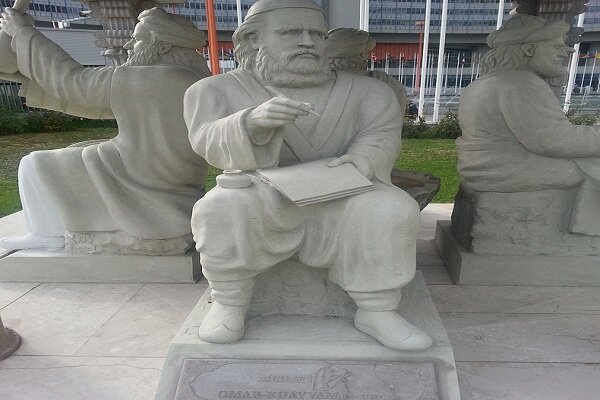

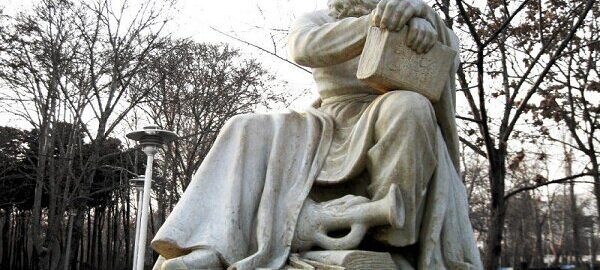
The statue of Khayyam in United Nations Office in Vienna as a part of Persian Scholars Pavilion

Khayyam studied science, philosophy, mathematics, and astronomy at Nishapur, and about the year 1068, he traveled to Bukhara, where he frequented the renowned library of the Ark. However Khayyam was an outstanding mathematician and astronomer and he did write several works including Problems of Arithmetic, a book on music and one on algebra before he was 25 years old.

In 1070 he moved to Samarkand in Uzbekistan where there Khayyam was supported by Abu Tahir, a prominent jurist of Samarkand, and this allowed him to write his most famous algebra work, Treatise on Demonstration of Problems of Algebra. It is presumed that due to his relationship with Tahir, ruler Shams al-Mulk distinctively regarded Omar with esteem.

Toghril Beg, the founder of the Seljuq dynasty, had made Isfahan the capital of his domains and his grandson Sultan Malik-Shah I was the ruler of that city from 1073. An invitation was sent to Khayyam from Malik-Shah and from his Grand Vizier Nizam al-Mulk asking Khayyam to go to Isfahan to set up an Observatory there and lead a group of scientists in carrying out precise astronomical observations aimed at the revision of the Persian calendar.


Jalali calendar by Khayyam

It was a period of peace during which the political situation allowed Khayyam the opportunity to devote himself entirely to his scholarly work. During this time the scientist measured the length of a year – tropical year length – with remarkable precision. The resulted calendar was named in Malik-Shah’s honor as the Jalali calendar and was inaugurated on March 15, 1079. The Jalali calendar was a true solar calendar where the duration of each month is equal to the time of the passage of the Sun across the corresponding sign of the Zodiac.

This calendar was used until the 20th century in Iran and it became the official national calendar of Qajar Iran in 1911. This calendar was simplified in 1925 and the names of the months were modernized, resulting in the modern Iranian calendar.

After the death of Malik-Shah and his vizier in 1092, Khayyam fell from favor at court and funding to run the Observatory ceased, and Khayyam’s calendar reform was put on hold. Despite being out of favor on all sides, Khayyam remained at the Court and tried to regain favor. He wrote a work in which he described former rulers in Iran as men of great honor who had supported public works, science, and scholarship.

He was then invited by the new Sultan Sanjar to Marv, possibly to work as a court astrologer. Sanjar created a great center of Islamic learning in Marv where Khayyam wrote further works on mathematics. He was famous during his life as a mathematician.

‘A commentary on the difficulties concerning the postulates of Euclid’s Elements’, ‘On the division of a quadrant of a circle’ and ‘On proofs for problems concerning Algebra’ are among his surviving mathematical works.

Outside the world of mathematics and astronomy, Khayyam is also best known as a result of Edward Fitzgerald’s popular translation in 1859 of nearly 600 short four-line poems the Rubaiyat.
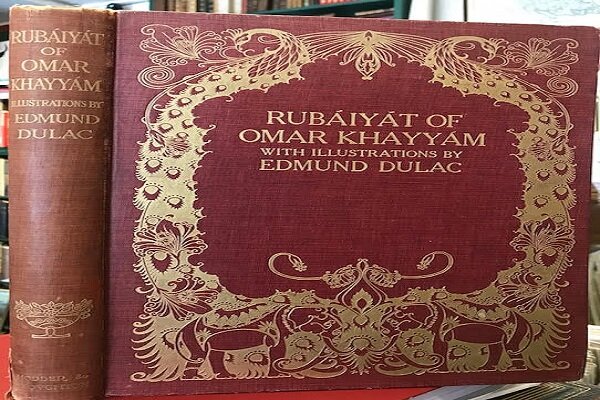

Rubaiyat of Omar Khayyam

Khayyam’s fame as a poet has caused some to forget his scientific achievements which were much more substantial. Versions of the forms and verses used in the Rubaiyat existed in Persian literature before Khayyam, and only about 120 of the verses can be attributed to him with certainty.

The poems celebrated the pleasures of life while illuminating the nuanced political and religious context in which they were created. Of all the verses, the best known is the following:

The Moving Finger writes, and, having writ,

Moves on: nor all thy Piety nor Wit

Shall lure it back to cancel half a Line,

Nor all thy Tears wash out a Word of it.

He also considered himself intellectually to be a student of Avicenna. There are six philosophical papers believed to have been written by Khayyam. Philosophy, jurisprudence, history, mathematics, medicine, and astronomy are among the subjects mastered by this brilliant man.
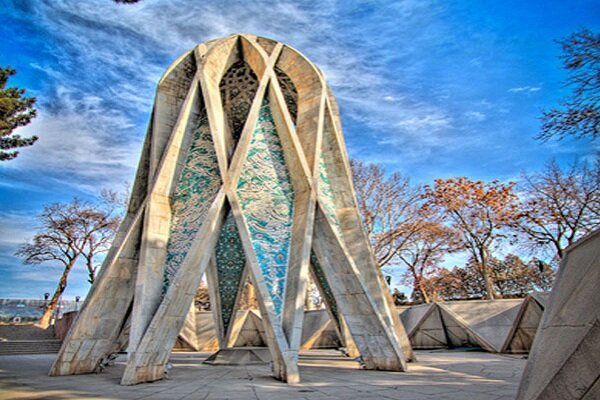

Mausoleum of Omar Khayyam in Nishapur

Khayyam died in Nishapur at the age of 83, on December 4, 1131. His mausoleum is a modern monument of white marble erected over Omar Khayyam’s tomb located in Nishapur. Although the tomb witnessed many calamities, it is not ruined and can host avid tourists from around the world.

In 1934, the reconstruction of the mausoleum was commissioned and Hooshang Seyhoun, who was the supervisor of national monuments constructions with Hossein Jodat, transferred the place of the tomb, and this process continued till 1962. The triangular parts around the tomb are associated with a tent that implies Khayyam’s name.

The Mausoleum of Khayyam is one of the most important buildings of that period in terms of creativity, construction, and architecture. This monument was registered in the list of National Heritage in 1963.
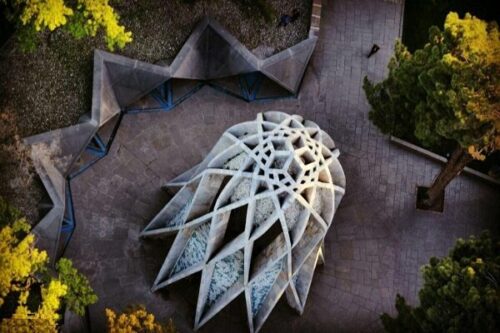

Aerial view of Mausoleum of Omar Khayyam in Nishapur

Ordibehesht 28 in the Persian calendar corresponding with May 18 is the commemoration day of the world-renowned Persian poet, astronomer, and mathematician Omar Khayyam. Every year, a number of literati and scholars from around the world convene at the mausoleum of Khayyam to mark his National Day.

A ceremony is traditionally held on this day in his mausoleum in Nishapur, as well as in many other locations across the country and worldwide. /MNA/

Iran in third place of Deaflympics medal table

Iranian athletes claimed 14 gold, 12 silver and 14 bronze medals in the 2021 Summer Deaflympics in Caxias do Sul, Brazil.

Ukraine won 61, 38 silver and 38 bronze medals in total and claimed the title.

The U.S. finished in second place, winning 19 gold, 11 silver and 25 bronze medals.

The Iranian delegation took part in the 24th edition of the games in eight sports in athletics, beach volleyball, football, judo, karate, shooting, taekwondo and wrestling.

“Success in Silence” was Iran’s official motto in the competition. /T.T/

National Day of Ferdowsi; Father of modern Persian language

Ordibehesht 25 in the Persian calendar corresponding with May 15 is the National Commemoration Day of the renowned poet Ferdowsi, the influential Persian poet and author of the Persian epic, Shahnameh.

Abul-Qasem Ferdowsi Tusi (940 – 1020Ad) was born in Tus in Khorasan which is situated in today’s Razavi Khorasan province in Iran. Little is known about Ferdowsi’s early life.

According to some data, Ferdowsi was a landowner, deriving a comfortable income from his estates. These were landowning Iranian aristocrats who had flourished under the Sassanid dynasty. Ferdowsi grew up in Tus, a city under the control of one of these dynasties, the Samanids, who claimed descent from the Sassanid general Bahram Chobin (whose story Ferdowsi recounts in one of the later sections of the Shahnameh).

Ferdowsi’s Shahnameh (‘The Book of Kings’) is the most popular and influential national epic in Iran and other Persian-speaking nations. The Shahnameh is the only surviving work by Ferdowsi regarded as indisputably genuine.

Ferdowsi started writing the Shahnameh in 977 AD and completed it on 8 March 1010. He spent over three decades writing the Shahnameh.

It is the national epic of the Iranian people that describes the history of Persia from ancient times until the Islamic conquest in the 7th century. The Shahnameh is an epic poem of over 50,000 couplets, written in early Modern Persian.

The result of his work is the world’s longest epic poem written by a single author; it is three times as long as Homer’s Iliad and Odyssey combined. The book about the Persian kings, written entirely in Persian, played a key role in the revival of this language and made a significant contribution to the development of Persian literature.

The romance of Zal and Rudaba, the Seven Labors of Rostam, Rostam and Sohrab, Siavash, and Sudaba, the romance of Bizhan and Manizheh and Rostam and Esfandyar are among the most popular Shahnameh stories.

Here are some lines from his poems in which Ferdowsi concludes the Shahnameh by these lines, translated by Dick Davis:

“I’ve reached the end of this great history

And all the land will talk of me:

I shall not die, these seeds I’ve sown will save

My name and reputation from the grave,

And men of sense and wisdom will proclaim

When I have gone, my praises and my fame”

Ferdowsi is one of the undisputed giants of Persian literature. After Ferdowsi’s Shahnameh, a number of other works similar in nature surfaced over the centuries within the cultural sphere of the Persian language. Without exception, all such works were based on the style and method of Ferdowsi’s Shahnameh, but none of them could quite achieve the same degree of fame and popularity as Ferdowsi’s masterpiece.

Ferdowsi has a unique place in Persian history because of the strides he made in reviving and regenerating the Persian language and cultural traditions. His works are cited as a crucial component in the persistence of the Persian language, as those works allowed much of the tongue to remain codified and intact. Many modern Iranians see him as the father of the modern Persian language.

The Persians regard Ferdowsi as the greatest of their poets. For nearly a thousand years they have continued to read and listen to recitations from his masterwork, the Shahnameh, in which the Persian national epic found its final and enduring form.

Ferdowsi died in 1020 AD in the Tus in the same city in which he was born. Ferdowsi was buried in his own garden. A Ghaznavid governor of Khorasan constructed a mausoleum over the grave and it became a revered site.

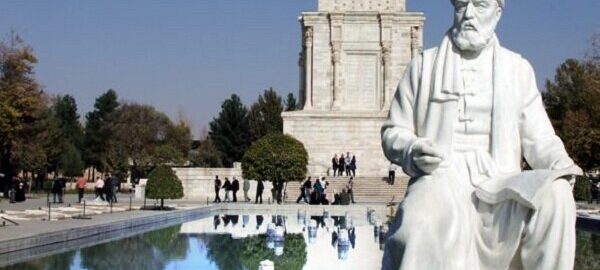
The Tomb of Ferdowsi, which resembles the tomb of Cyrus the Great, is built in the style of Achaemenid architecture. It is a tomb complex composed of a white marble base, and a decorative edifice erected.

Today, Ferdowsi’s tomb is one of the tourist attractions in Iran. Millions of visitors from various provinces of Iran come to see the tomb every year. Foreign dignitaries, tourists, and other Persian-speaking people from Europe, Asia, and the Middle East also visit the site.

The site has also inspired many Persian poets including Iranian poet Mehdi Akhavan-Sales who is actually physically buried not far from the tomb of Ferdowsi, in his own tomb on the grounds of Ferdowsi’s complex.

Today is the National Commemoration Day of the great Iranian epic poet Ferdowsi. Every year, a number of literati and scholars from around the world gather at the mausoleum on May 15 to commemorate the great Persian. /MNA/

“Lady of the City” crowned best at Sydney World Film Festival

Iranian drama “Lady of the City” was selected as the best narrative feature film at the 13th edition of the Sydney World Film Festival in Australia, the organizers announced on Monday.

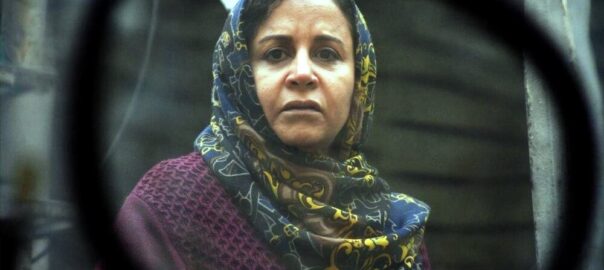
Directed by Maryam Bahrololumi, the film, also known as “Shahrbanoo”, follows Shahrbanoo, a woman who has been sentenced to life in prison for being a drug mule. After eleven years in jail, she is released from prison for a few days to attend her son’s wedding. The temporary freedom helps her see a new aspect of her life and that of her family before returning to prison.

The award for best narrative short went to “Mamma” by Norwegian director Aslak Danbolt.

The film is about Synnove, who is searching for her drug-addicted daughter Michelle in an almost desolated city on Christmas Eve. Mother and daughter in real life, Synnove and Michelle play versions of themselves in a story that is very close to their own lives.

“Everyone Wants to Be the Next Weismann” by Spanish filmmaker Alberto Triano was named the best documentary feature film.

Contemporary art collector and first to discover the great Richard Weismann, Martin Solo takes on the challenge of introducing the world to his unique vision of art by opening his private museum to the public. For this, Martin prepares a retrospective of his latest discovery: Mu Pan, a Taiwanese, Brooklyn-based artist, whose fantastical works criticize and reflect the violence and brutality of society. Martin feels he failed with Richard Weismann but this time he is prepared to lay all of his cards on the table.

Norwegian director Martin A. Walther’s “The Psychlist” was selected as best documentary short film. The film is about Per who chooses the bicycle as the only escape after his 11-month-old daughter died under tragic events.

The award for best animated film was given to “Poise” by Luis Soares from Portugal, while Australian director Sofie Mcclure’s “Phosphenes” won the best experimental film award.

“Dynamite” by French filmmaker Jim Vieille was named best music video and “Upsodown” by Nathan Ceddia was picked as best Australian film. /T.T/

Iran has capacity to increase share of medical equipment market

Iran holds a share of one percent (about $5 billion) in the global market for medical equipment of approximately $500 billion, but the country has the potential to increase the share, according to the statistics of the Ministry of Health.

In 2018, the National Medical Device Directorate reported that the Iranian medical equipment market was worth $2.5 billion, 30 percent of which belonged to over 1,000 domestic firms.

On a global scale, 56 percent of 500,000 medical equipment items available in the world market have Iranian versions. In pharmaceuticals, around 70 percent of Iran’s $4.5 billion markets are domestic products and, in 2018, 97 percent of pharmaceuticals consumed in the country were manufactured locally.

Iranian companies producing medical equipment export their products to 54 countries across the world. In 2018, 67 percent of the active pharmaceutical ingredients (APIs) used to produce drugs in Iran were made locally.

A total of 227 knowledge-based firms are supplying medical equipment for health centers across the country, according to the Vice Presidency for Science and Technology.

Iranian companies producing medical equipment export their products to 54 countries across the world.

Iran Health expo which is to be held on May 24- 27 is also a platform for international medical manufacturers to demonstrate their products and services annually at the International Permanent Fairground in Tehran. This event showcases and covers a wide spectrum of products like medical devices, health care services, laboratory equipment, hospital equipment, pharmaceutical products and services associated with this field, etc. This event would also have several concurrent Medical Workshops and B2B Meetings covered in dentistry, laboratory, and pharmaceutical domains.

The 23rd edition of the international exhibition of medical, pharmaceutical & laboratory equipment (Iran Health) will take place at Tehran International Fairground. Iranian and non-Iranian companies and organizations gather to exchange their scientific and technical knowledge, technologies, potentials, and demands. /T.T/

Susa, a cradle of civilization

Situated between the Karkheh and Dez rivers in southwest Iran, Susa was once one of the most important and glamorous cities of the ancient world.

Susa, which is inhabited for thousands of years, embraces several layers of superimposed urban settlements from around the late 5th millennium BC until the 13th century CE.

The ancient town served as the capital of Elam (Susiana) and the administrative capital of the Achaemenian king Darius I and his successors from 522 BC.

Historically speaking, Susa was once part of the historic kingdom of Elam between Babylon and ancient Persia as the lower Zagros Mountains of Persia descend into the Mesopotamian region.

In a story published by The Travel website on Sunday, People may be familiar with it as being the capital of the Persian Empire in the Book of Esther. According to that account, it was here that Esther was wed to the powerful Persian Emperor and managed to bravely save her Hebrew people from annihilation.

Moreover, Susa continued its magnificence and remained a strategic center during the Parthian and Sasanian periods, the empires that ruled this region during the Roman period.

Today Susa is made up of three archeological mounds and covers around a square kilometer. On top of the archeological site is the modern Iranian town of Shush. One may visit the excavated mounds and try to imagine what it was like during its heyday as the capital of what was then the largest Empire in the world. Furthermore, at the archeological site, one can see Ardeshir’s palace, various excavated administrative, residential, and other monuments.

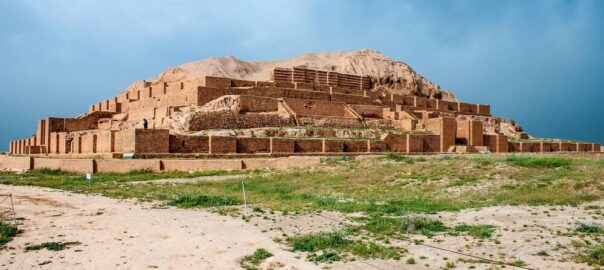
Very close to the ancient site of Susa is one of the best-preserved ziggurats in the world. Also in Iran is the Sialk Ziggurat which is one of the oldest known ziggurats dating from the early 3rd millennium BC. Most of these Mesopotamian Pyramids are in what is today Iraq, but some are in Iran.

The ancients believed that the ziggurats connected heaven and earth – shown in that the name of the ziggurat at Babylon (Etemenanki) means “House of the foundation of heaven and earth.” It is thought that the famous tail in the Bible of the Tower of Babel is a reference to the ziggurats of Mesopotamia.

Unlike other temples, Mesopotamian ziggurats were not places for public worship or ceremonies. They were just the dwelling places for the gods. And the purpose was to get the temple closer to the heavens. The temple complex of which the ziggurats were a part included storage rooms, bathrooms, living quarters, and a courtyard.

Susa is part of a region often termed a cradle of civilization. The city appears in the very earliest Sumerian records and is one of the first recorded cities in human history. /T.T/