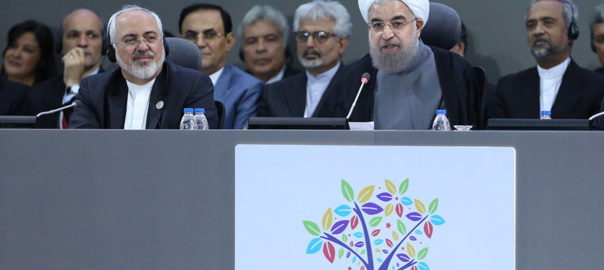
President Rouhani delivered a report on Iran’s activities and achievements during its 4-year presidency over Non-Aligned Movement and explained Iran’s stances and viewpoints towards the most important regional and international issues.
During the opening ceremony of the 17th NAM Summit that is being held in Venezuela’s Margarita Island, Dr Rouhani also said: “Members of our movement, more than any other time, are in need of solidarity, unity and coordination”.
Referring to regional challenges, President Rouhani continued: “The Islamic Republic of Iran considers talks and negotiations as the best solution to resolve global and regional conflicts”.
“The JCPOA is a new strategy and approach for positive and constructive engagement to resolve crises and challenges through peaceful means,” said Rouhani stating that Tehran welcomes political means to end crises in the war-stricken countries of the Middle East.
On Palestine and the Zionist regime’s occupying the Palestinian lands, he said: “The Islamic Republic of Iran, based on its religious beliefs and deserving national and human values, has always prioritized supporting the people and causes of Palestine and we believe that defending the rights of the people of Palestine is not limited to a particular race or religion but it is a humanitarian issue which is the obligation of us all”.
Below is the full text of President Rouhani’s speech at the 17th Summit of Non-Aligned Movement:
In the Name of God, the Most Compassionate, the Most Merciful
Honorable Heads of State and Government
Honorable Ministers
Ladies and Gentlemen
At the outset on behalf of the Government of the Islamic Republic of Iran, I would like to appreciate the people and Government of the Bolivarian Republic of Venezuela for the cordial hospitality extended to me and my delegation during the seventeenth summit meeting of the Non-Aligned Movement.
During the past four years that Iran was honored to assume the presidency of the Non-Aligned Movement, it utilized the capacities of our movement in combination with its own capabilities, to attain the noble goals of the movement and improve the efficiency of its subsidiaries. During this period, the Coordination Office, the Troika of NAM, its working groups in the United Nations and the Security and Peace Consolidation Council held more than 450 meetings in New York. The Non-Aligned Movement was also seriously involved in many other activities in the United Nations headquarters in Geneva, Vienna, the Hague as well as the UNESCO. The outcome of these meetings has been the declaration of the clear stances of the Non-Aligned Movement concerning important global issues such as disarmament, reforming the UN structure and maintaining peace and human rights.
We are all aware that the Non-Aligned Movement can realize its capabilities only when all the member states cooperate in promoting consolidation and improving efficacy. Therefore, in this period, many efforts have been made to enhance synergy, consolidate bonds and promote understanding among the Member States. Also, several rounds of serious negotiations were held with the North countries to transmit the message of the Non-Aligned Movement and strengthen our position. Similar negotiations were conducted between the NAM Troika and the European Union Troika. Such negotiations demonstrate our will to promote the goals and principles of the Non-Aligned Movement. All such activities have been included in detailed reports presented to this meeting.
Having assumed the presidency of the Non-Aligned Movement for four years, the Islamic Republic of Iran is now proud to hand over this grave responsibility to the friend country, Venezuela. I hope that with the efforts and commitments of Venezuelan officials to this important responsibility, we would experience another successful period with the support of all the Member States for the activities of the No-Aligned Movement. Without doubt, the approvals and outcome of this significant summit with the slogan of “peace, sovereignty and solidarity for development” are yet another important step towards the realization of the noble goals of our movement. Here, I deem it necessary to appreciate the positive and constructive contribution and cooperation of all the NAM Member States with the Islamic Republic of Iran during its presidency. Without the active cooperation and participation of all the Member States, particularly those states that assumed responsibilities of various mechanisms of our movement in different headquarters of the United Nations, the present achievements could have never been accomplished.
Distinguished Participants
This summit is convening at a time when peace is being threatened in all its aspects across the world and the national sovereignty of developing states is being constantly violated in various forms and methods. Members of our movement, more than any other time, are in need of solidarity, unity and coordination. The fact of the matter is that we as a group that constitute about two thirds of the United Nations members are now an undeniable part of solutions for the present challenges of the world.
What unfolds in the contemporary international order, is worrying if we adopt a realistic perspective. In today’s global relations, hegemonic and domineering inclinations are incontrovertible reality. Alignment towards military polarizations and blocks is another dominant feature in the mentality and behaviors of some of the players. Arms race, warmongering, intensification of conflicts and violence and interfering in the domestic affairs of developing nations by the holders of power and wealth, overtly or covertly, are only examples of such behavior which cannot be interpreted unless with the logic of hegemony-seeking and predominance.
Ladies and Gentlemen
It is noteworthy to mention that the main principles and goals of the Non-Aligned Movement have been designed and set in a manner considered by all countries as fundamental criteria which could guarantee the independence, territorial integrity and sovereignty of states and improve their national interests, good neighborliness and peace, security and stability at the global level. Many of the present critical challenges and serious crises can be settled in the most appropriate manner if we follow such goals and principles.
In the Islamic Republic of Iran, since the victory of the Islamic Revolution in 1979 which founded our foreign policy on the rejection of the West together with the East, we have been acting in compliance with the spirit of the Non-Aligned Movement. During these years, we have adhered to the belief that it is possible to engage with other countries and enter into constructive interaction with the world—a world that should represent its human-oriented and fair image in the same manner suggested by the causes of the Non-Aligned Movement—a world which should adapt itself with the dynamism of political developments.
As against the unreal fundamentalist images of Iran portrayed by propagandist and warmonger media, my country has never followed an approach to suggest its national interests collide with global interests. And our support for the world’s righteous movements does not mean confrontation with accepted and legitimate human values. Nor does it mean interference in the internal affairs of the others. Conversely, Iran’s discursive doctrine, originating from religious causes, is against imperialism and global trouble-making which is in accordance with the new intellectual developments and global freedom-seeking literature as well as the Charter of the United Nations. Causes such as independence, freedom, republicanism, democracy and self-determination through the ballot box are considered as not only religious and national but also global values.
In recent years, disappointing and unpleasant events for the people of Syria, Yemen, Iraq and Libya as the result of selfish and destructive competition among specific states have hurt the consciousness of people across the world, signaling the irresponsibility of the big powers towards avoidable wounds inflicted every day on innocent bodies. The world is aware that the Islamic Republic of Iran was the first country which warned against the global danger of Takfiri terrorism in Syria. While a number of irresponsible groups in the Middle East and the West were busy equipping and training Takfiri terrorists, Iran stood against Iraq and Syria to confront alone with one of the most brutal terrorist organizations of history. The hands of such groups and their financial and military supporters are spattered in blood which will never drain. It was like a historical satire when the brutal attacks of these groups spread outside Syria and supporters of Takfiri terrorists decided reluctantly to form an inefficient and hollow coalition against terrorism. This is while the global community has so far failed to restore the violated rights of the people of Palestine and end the occupation. Not only have big powers not helped alleviate these pains, but they are playing a notorious role in the escalation of violence, murder, war, poverty and displacement of millions of people in the developing states. All these events are indication of the fact that we should not pin our hope on big powers to achieve security, development and progress. Unfortunately, a small number of Non-Aligned Movement Member States have betrayed the primary principles of our movement and are playing a role in disrupting peace and interfering in the internal affairs of other Member States by accompanying the terrorists.
These misguided policies have had no outcome but destruction and historical dishonor for these countries and the terrorist groups supported by them. The divine tradition and historical experience recognize the reality that denying legitimate demands of nations would bring about nothing but enormous costs and dishonor. Moreover, the aggressor powers and interventionists will have no option but to surrender against the demands of the nations.
I, on behalf of the noble people of Iran, proposed a resolution on the World Against Violence and Extremism to the United Nations General Assembly which resulted in the adoption by consensus of two resolutions in 2013 and 2015. In our belief, the fight against extremism and terrorism requires constructive and honest cooperation among all the members of the international community. On such a basis, I proposed to last year’s General Assembly of the United Nations the necessity of forming a “united front for the fight against extremism and violence”. The Non-Aligned Movement enjoys a large capacity for the advancement of such ideas within the framework of the United Nations.
Ladies and Gentlemen
The present challenges in various parts of the world should not make us oblivious to the issue of Palestine and its oppressed people. The people of Palestine remain deprived of the right to hold their own territory and state and return to their motherland. The oppression which is today suffered by the Palestinians epitomizes an institutionalized violence which cannot be described only by apartheid. The Zionist regime is trying to exploit the current developments in the Middle East especially the emergence and spread of terrorist and extremist groups such as Daesh in order to overshadow its crimes against the oppressed people of Palestine and other nations of the region. The Islamic Republic of Iran, based on its religious beliefs and deserving national and human values, has always prioritized supporting the people and causes of Palestine. We believe that defending the rights of the people of Palestine is not limited to a particular race or religion but it is a humanitarian issue which is the obligation of us all. We have not conditioned defending Palestinians on momentary developments or even some misguided policies. And we are proud that the Iranian nation and government have stood beside the oppressed and resistant people of Palestine in any circumstances.
Distinguished Participants
The pillars of the foreign policy of the Islamic Republic of Iran are founded on the policy of moderation, prudence and interaction to settle conflicts and differences and misunderstandings through dialogue and cooperation. On such a basis, despite the hostile measures and extensive political and economic pressures on my country under the excuse of the nuclear issue, the Islamic Republic of Iran emphasized right from the beginning on holding constructive negotiations. Ultimately, talks between Iran and the 5+1 group of countries resulted in the conclusion of the Joint Comprehensive Plan of Action (JCPOA). The widespread support offered to the peaceful nuclear program of Iran by the Non-Aligned Movement and its support for the nuclear negotiations played an effective role in guaranteeing the legitimate nuclear rights of Iran and other developing states.
Iran’s nuclear deal with the big powers is significant from various perspectives. The benefit and advantages of the recognition and enforcement of inalienable nuclear rights of Iran are not limited to Iran only but the resistance of Iranians against such pressures stopped a dangerous procedure in international arena to deprive other nations from their fundamental and legitimate rights to access nuclear energy for peaceful purposes. In addition, the constructive outcome of these negotiations represents the reality that long term and sophisticated crises can be handled only through talks, peaceful mechanisms and the adoption of a win-win approach. In fact, the JCPOA is not a sole political deal. In the current turbulent world in which the use of weapons and violence is prevalent, the JCPOA is a new strategy and approach for positive and constructive engagement to resolve crises and challenges through peaceful means. The JCPOA can mark a beginning for bilateral and multilateral cooperation among the countries for the advancement of peace and development the world over.
The Islamic Republic of Iran considers talks and negotiations as the best solution to resolve global and regional conflicts. Iran has in fact been a pioneer in engaging in dialogue and talks. We will consider positively any initiative at the regional level which is based on talks and negotiations to end the present conflicts and differences. No single country is able to create alone a new order in the region due to the nature of the problems in the Middle East region. Creating a new order in the region is only applicable through cooperation and the collective participation of all the neighbors.
We welcome political means to end crises in the war-stricken countries of the Middle East. National talks should be conducted without the interference of outside powers and with the participation of legitimate beneficiary groups. And ultimately, the ballot box should be determining the destiny of these countries. All governments in the region should feel sensitive towards the human catastrophes and destruction of the economic and social infrastructure throughout the whole region from Yemen to Iraq and Syria and stop supporting terrorists for political purposes. Any action against the terrorists should be taken in a manner that causes minimum damage to innocent people and civilians.
In conclusion, I once again announce the readiness of the Islamic Republic of Iran for more extensive and active cooperation with all the member states of the Non-Aligned Movement and particularly with the friend and brother country, Venezuela as the new rotating chair of the Non-Aligned Movement for the advancement of the goals and approvals of this meeting. / Tehran times /