All posts by islam

Iran Auto Firms Production Target 3 million units

Automakers are aiming at a production rate of 3 million units over the next eight years, says the investment director of the Industrial Development and Renovation Organization of Iran (IDRO).

“The Ministry of Industries, Mining and Trade aims to increase Iran’s annual auto production to 3 million units by 2025,” Fardad Daliri said in an interview with the news website Iran Online.

According to plans, 30% of the cars would be exported, he added.

The International Organization of Motor Vehicle Manufacturers says Iran automakers produced 1,074,000 cars and 90,710 commercial vehicles in 2016, recording an 18.6% growth.

If the automakers maintain this rather ambitious growth rate until 2025, they will have reached a production figure of 4 million cars per year. Therefore production of 3 million cars by 2025 “is not farfetched.”

However, Daliri admitted that “The current [poor] quality of locally-produced cars limits Iran’s target markets to a handful of countries.”

As per the Trade Promotion Organization, affiliated to the Ministry of Industries, local automakers exported vehicles worth $36.6 million in the last fiscal (ended March 20). Iraq, Algeria, Lebanon, Turkmenistan and Syria were the main destinations.

Question of Quality

Daliri said the Iran Standard and Quality Inspection Company (ISQI) and the Ministry of Industries are working on a new protocol to help upgrade standards for the automotive sector.

“Emission standards, fuel consumption and safety features will be upgraded.”

He noted that several models that are being produced for over a decade would fail to comply with the new standards unless their production platforms get up-to-date.

A recent spat between the director of ISQI and CEO of SAIPA brought the issue of the ageing auto production lines into the spotlight.

The managing director of SAIPA dismissed public comments made by the ISQI chief, Nayereh Piroozbakht, about “outdated cars and the need to ban their production.”

She was obliquely referring to the low quality SAIPA’s Pride and Iran Khodro’s Peugeot 405, which have never risen above one star in ISQI’s five-star ranking system.

SAIPA boss Mahdi Jamali said, “Ms. Piroozbakht is overstepping her boundaries…The ISQI is simply not in a position to say whether or not a car should be produced.”

He claimed that “there is ample demand for Pride and SAIPA will continue producing the model till there is demand.” Pride models made by the second-biggest carmaker in Iran are the cheapest cars in the domestic market.

Daliri is of the opinion that “Carmakers will not quit profitable but unsustainable projects [like production of Pride] unless mandatory policies and stringent implementation rules are demanded by the state.”

Iranian carmakers are trying to upgrade their production platforms through joint ventures with foreign firms and local research centers, he said.

The IDRO official warned that in case the Pride and Peugeot 405 platforms do not get upgraded by March 2018, “their production will be banned.”

“The vehicles’ body design, engine and gearbox need to change.”

SAIPA’s Pride has been produced since 1993 in Iran. The model is based on KIA Pride which was first produced in 1987 in South Korea and Japan.

Peugeot 405 — which latter was offered as Peugeot Pars with slightly different options — has been domestically produced since 1991. The model was first released by the French carmaker in 1987.

/ Financial tribune /

Rose harvest season in southern Iran

Harvesting Damask rose, known as Gol-e Mohammadi in Iran, is an annual practice in Meymand, a city in the southern province of Fars.  The city produces over 10,000 tons of rose water out of the flower, accounting for over 60 percent of Iran’s rose water export.  Iranians use Damask rose in cooking, tea serving, and celebrations in its various forms, although it doesn’t play much part in the Western societies.  The flowers are also renowned for their fine fragrance, and are commercially harvested for extracting rose water and oil.  /Tehran times /

Queen Bee Distribution in Tehran

Tehran’s Agricultural Jihad Organization has begun distributing queen bees among the province’s beekeepers, the  deputy head of the organization said.

“Around 970 tons of honey are produced in Tehran Province every year,” Abbas Akbari was also quoted as saying by IRNA on Sunday.

According to Deputy Agriculture Minister Hassan Rokni, 81,500 tons of honey were produced throughout Iran in the last fiscal year (ended March 20, 2017). He added that the figure is expected to rise 5.5% to reach 86,000 tons in the current year.

“A total of 993 kilograms of royal gel were produced in the country last year, priced at 50 million rials (about $1,330) per kilogram,” he said.

Rokni noted that per capita honey consumption in Iran stands at about 1 kg while the global annual average is 250-300 grams. About 75,000 people are active in Iran’s beekeeping industry.

/ Financial tribune /

59% Rise in Fars Tourists

Fars Province in southern Iran hosted more than 69,000 foreign tourists in the Iranian month of Farvardin (March 21–April 20), registering a 59% increase compared with the same period of last year.

According to Mosayyeb Amiri, the head of the provincial office of Iran’s Cultural Heritage, Handicrafts and Tourism Organization, a majority of tourists were from France, followed by Germany, Italy, Spain and the Netherlands, Donyayesafar.com reported.

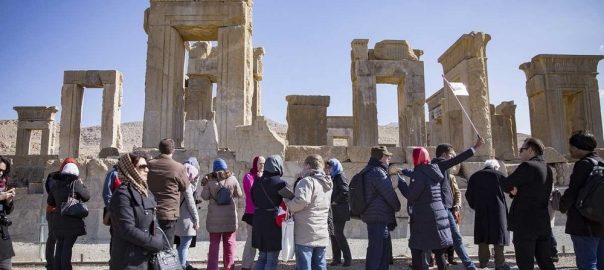
The official said Persepolis had 15,338 visitors, while Naqsh-e Rostam, an ancient necropolis located about 12 km northwest of Persepolis, received 12,869 tourists. The tomb of renowned Persian poet, Hafez, was visited by 11,480 people.

A total of 10,021 tourists visited Pasargadae where the tomb of Cyrus the Great, founder of the Achaemenid Empire, is located.

Shiraz, the capital of Fars Province, is one of the oldest Iranian cities and home to four world heritage sites: Pasargadae and Persepolis, the Achaemenid Empire’s (550–330 BC) administrative and ceremonial capitals respectively; and Pasargadae and Eram Garden, two of Iran’s nine entries inscribed collectively as the Persian Garden. / Financial tribune /

Visitors take a tour of the old citadel arg of Karmin Khan in the centre of the city.

Fajr Golden Simorgh remains at home for “The Home”

The Golden Simorgh for best film at the 35th Fajr International Film Festival remained at home as Iranian drama “The Home” by producer/director/writer Asghar Yusefinejad won the award on Thursday.

Yusefinejad received the award from Cinema Organization of Iran (COI) director Mohammad-Mehdi Heidarian during the closing ceremony of the festival at Tehran’s Vahdat Hall.

In his acceptance speech, Yusefinejad dedicated his award to world-renowned Iranian filmmaker Abbas Kiarostami and his homeland Tabriz.

In announcing the best film winner, Iranian actress Fatemeh Motamed-Arya, who was a member of the jury, said that all seven members of the panel were amazed by “The Home”.

The film, which is Yusefinejad’s directorial debut, also brought him the Silver Simorgh for best screenwriter.

The movie tells the story of Sayeh, who has broken off relations with her family after marriage. Her father dies and she returns home to attend his funeral, but in his last will and testament, he has asked that his remains be donated to an academic center for autopsy. However, Sayeh is diametrically opposed to the idea.

Yusefinejad also received the NETPAC Award, which is presented by a jury assigned by the Network for the Promotion of Asian Cinema (NETPAC).

The best director award went to Iván D. Gaona for his debut “Guilty Men” from Colombia.

Stefan Denolyubov was selected as best actor and his co-star Margita Gosheva won the best actress award for their roles in “Glory” by Bulgarian directors Kristina Grozeva and Petar Valchanov.

The special jury award was shared by art director Wang Tou and cinematographer Jinjing Zhu for their collaboration in “Mr. No Problem”, a joint Chinese-French production by director Feng Mei.

“Online Shopping” by Iranian filmmaker Qasideh Golmakani won the best short film award.

“Babai” by Mozaffar Hosseinkhani won the Muhammad Al-Ameen Award, which is presented to films promoting Islamic ethics and morality.

COI director Mohammad-Mehdi Heidarian, Minister of Culture and Islamic Guidance Reza Salehi-Amiri, Minister of Foreign Affairs Mohammad-Javad Zarif and actor Reza Kianian were called to the stage to present the award.

Kianian called Zarif a “national hero who has maintained Iranian’s national pride” and asked him to present the award.

The best film award in the Eastern Vista, which screens movies from Asian filmmakers, went to “Returnee” by Kazakh director Sabit Kurmanbekov.

Sharbanoo Sadat from Afghanistan was named best director for her movie “Wolf and Sheep” in this section.

“Not Yet” by Iranian director Aryan Vazir-Daftari was picked as best short.

In the Inter-Religion section, “Knife in the Clear Water”, Chinese director Wang Xuebo’s debut that focuses on Uighurs and their separatist movement, won the best film award.

/ Tehran times /

Mo’aven al-Molk, a distinctive shrine

A ceramic tilework bearing historical themes embellishes an exterior wall of the Takieh Mo’aven al-Molk, a distinctive Shia shrine, in western Iranian city of Kermanshah, April 25, 2017.

Completed in early 20th century, the Takieh  which is also a tourist destination boasts abundant tiles and stuccowork depicting a wide range of images, from Quranic scenes to pre-Islamic motifs including Shahnameh kings, edifices and local notables in 19th-century costumes. / Tehran times /

20 Million Tourists Visited Iran Since 2013

Some 20 million foreign tourists traveled to Iran from the summer of 2013 (when President Hassan Rouhani took office) up to the last Iranian year (ended March 20, 2016), the tourism deputy at Iran’s Cultural Heritage, Handicrafts and Tourism Organization.

During a press conference on Sunday, Morteza Rahmani Movahed added that since the current administration came to power, 19.9 million tourists visited Iran and injected $32 billion into the domestic economy, the Persian daily Shahrvand reported.

Since collecting and reporting data are one of Iran’s weakest attributes, reporters quizzed the official on the source of the statistics.

“A globally accepted definition of an international tourist is one who spends at least 24 hours in a foreign country,” he said.

“According to the UN World Tourism Organization, every tourist in West Asia spends between $1,520 and $1,750, so we used an average ($1,650) to calculate our revenue.”

In other words, the statistics by ICHHTO are approximate figures based on UNWTO estimates.

Last year, some 5.5 million tourists visited Iran, constituting nearly a quarter of the country’s ambitious 2025 target of 20 million annual tourists./ Financial tribune /

German violinist Susanne Zapf to hold master class in Tehran

German violinist Susanne Zapf will be holding a master class for a number of Iranian musicians in Tehran on April 29.

The master class is scheduled to be held at Tehran’s Da Theater House, the organizers announced in a press release on Tuesday.

Earlier in summer 2015, Zapf held a workshop in Tehran.

In addition, Zapf will accompany the Tehran-based ensemble Yarava in a concert at the Da Theater House early May.

Works by Iranian musicians Mehdi Jalali, Shahrokh Khajeh-Nuri and Farzia Fallah, and German composers Helmut Zapf and Sven-Ingo Koch will be performed at the concert.

Born in 1979 in Thuringia, Germany, Zapf particularly enjoys playing chamber music. In 2006, she founded a string quartet named “Sonar Quartet”, which specializes in playing contemporary music.

/ Tehran times /

Iran’s Apple Exports: $87m in 11 Months

More than 334,300 tons of apples worth close to 3.3 trillion rials ($87.1 million) were exported from Iran during the 11 months to February 18, the Islamic Republic of Iran Customs Administration announced.

The main customers of Iranian apples over the period were the UAE, Afghanistan, Pakistan, Azerbaijan, Georgia, Iraq, Turkmenistan, Russia, Oman, Kyrgyzstan, Kazakhstan, Kuwait, India, Qatar, Bahrain, Sudan and Turkey. /financialtribune.com /

500 Antique Cars on Show in Iran

A classic car show opened in the Kurdish city of Sanandaj, the capital of Kurdistan Province in west Iran, on April 20, with more than 500 vehicles on show for the first time. The Sanandaj Classic Car Show was held in the city’s Zolfaqar Nasab Stadium over the weekend with exhibitors from Hamedan, Kermanshah, and Baneh, the website Asre Khodro reported. According to a press release for the event, cars on show included Mercedes-Benz, Chevrolet, Jaguar, Fiat, Toyota, and Peugeot. Several older Iranian cars were also displayed including the locally produced Paykan made by the Roots Group and sold as a Hillman Hunter. Besides the classic cars, modifying companies were also present showing their latest technology to improve modern cars including wheel rims, tires, and in-car electronics. The event was hosted by the Youth and Sports Development Department of Sanandaj as well the city’s off-road motorcycle club. Specialized car shows are becoming a favorite pastime with people bringing out their much-loved vehicles for shows across the country.  /financialtribune.com/