All posts by islam

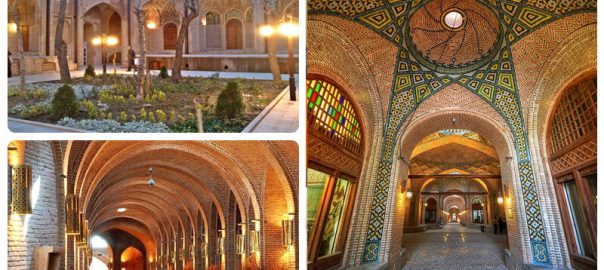
Sa’d al-Saltaneh jewel of Iran caravanserais, deputy tourism minister says

Iran has nominated 56 caravansaries for a collective inscription on the UNESCO list for World Heritage, deputy tourism minister Ali Darabi said on Saturday.

“[A selection of] 56 Iranian caravanserais will be registered on the UNESCO list… and Sa’d al-Saltaneh caravansary of Qazvin shines like a jewel among them,” the official said.

He made the remarks during a visit to Qazvin province when he called it a cradle of culture and arts, Mehr reported.

Located in the ancient city of Qazvin, the vast caravanserai is flanked by a beautifully restored Qajar-era bazaar of the same name.

For many travelers to Iran, staying in or even visiting a caravanserai can be a wide experience; they have an opportunity to feel the past, a time travel back into a forgotten age!

Qazvin was once the capital of the mighty Persian Empire, under Safavids, from 1548 to 98. It is a major tourist destination with a wonderfully restored caravanserai-turned-arts precinct, some quirky museums and a handful of decent eating options. For most travelers, Qazvin is also primarily the staging point for excursions to the famous castle of the Assassins and trekking in Alamut Valley. /T.T/

Iran marks National Day of Omar Khayyam

Today is considered a significant cultural event for Iranians to commemorate the great Persian poet, astronomer, writer, and mathematician Omar Khayyam.

Omar Khayyam was born on 18 May 1048 in Nishapur, in northeastern Iran, and spent most of his life near the court of the Karakhanid and Seljuq rulers in the period which witnessed the First Crusade.

A literal translation of the name Khayyam means ‘tent maker’ and this may have been the trade of Ibrahim his father.

The political events of the 11th Century played a major role in the course of Khayyam’s life. The Seljuq Turks invaded southwestern Asia in the 11th Century and eventually founded an empire that included Mesopotamia, Syria, Palestine, and most of Iran. The Seljuq occupied the grazing grounds of Khorasan and then, between 1038 and 1040, they conquered all of north-eastern Iran. The Seljuq ruler Toghrïl Beg proclaimed himself sultan at Nishapur in 1038 and entered Baghdad in 1055. It was in this difficult unstable military empire, which also had religious problems as it attempted to establish an orthodox Muslim state that Khayyam grew up.
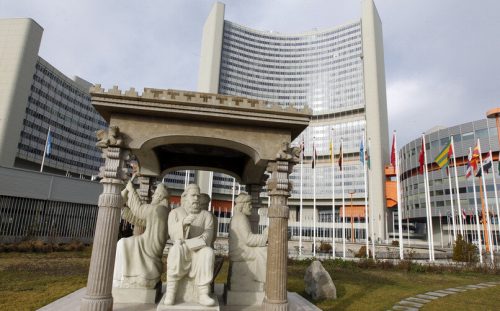

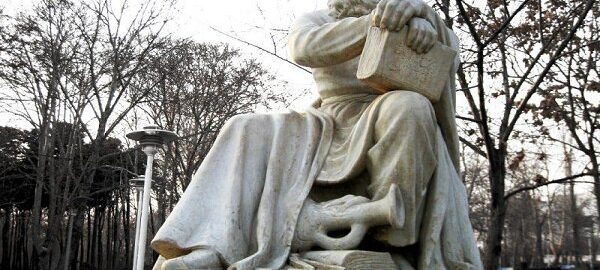
The statue of Khayyam in United Nations Office in Vienna as a part of Persian Scholars Pavilion
Khayyam studied science, philosophy, mathematics, and astronomy at Nishapur, and in about the year 1068, he traveled to Bukhara, where he frequented the renowned library of Ark. However Khayyam was an outstanding mathematician and astronomer and he did write several works including Problems of Arithmetic, a book on music and one on algebra before he was 25 years old.

In 1070 he moved to Samarkand in Uzbekistan where there Khayyam was supported by Abu Tahir, a prominent jurist of Samarkand, and this allowed him to write his most famous algebra work, Treatise on Demonstration of Problems of Algebra. It is presumed that due to his relationship with Tahir, ruler Shams al-Mulk distinctively regarded Omar with esteem.

Toghril Beg, the founder of the Seljuq dynasty, had made Isfahan the capital of his domains, and his grandson Sultan Malik-Shah I was the ruler of that city from 1073. An invitation was sent to Khayyam from Malik-Shah and from his Grand Vizier Nizam al-Mulk asking Khayyam to go to Isfahan to set up an Observatory there and lead a group of scientists in carrying out precise astronomical observations aimed at the revision of the Persian calendar.
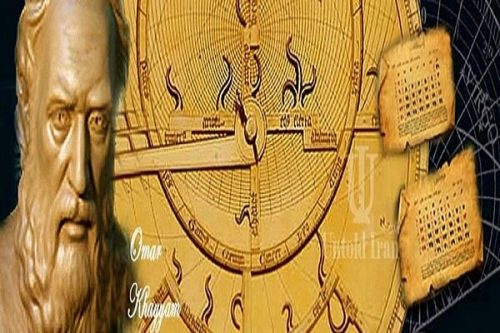

Jalali calendar by Khayyam
It was a period of peace during which the political situation allowed Khayyam the opportunity to devote himself entirely to his scholarly work. During this time the scientist measured the length of a year – tropical year length – with remarkable precision. The resulted calendar was named in Malik-Shah’s honor as the Jalali calendar and was inaugurated on March 15, 1079. The Jalali calendar was a true solar calendar where the duration of each month is equal to the time of the passage of the Sun across the corresponding sign of the Zodiac.

This calendar was used until the 20th century in Iran and it became the official national calendar of Qajar Iran in 1911. This calendar was simplified in 1925 and the names of the months were modernized, resulting in the modern Iranian calendar.

After the death of Malik-Shah and his vizier in 1092, Khayyam fell from favor at court and funding to run the Observatory ceased, and Khayyam’s calendar reform was put on hold. Despite being out of favor on all sides, Khayyam remained at the Court and tried to regain favor. He wrote a work in which he described former rulers in Iran as men of great honor who had supported public works, science, and scholarship.

He was then invited by the new Sultan Sanjar to Marv, possibly to work as a court astrologer. Sanjar created a great center of Islamic learning in Marv where Khayyam wrote further works on mathematics. He was famous during his life as a mathematician.

‘A commentary on the difficulties concerning the postulates of Euclid’s Elements’, ‘On the division of a quadrant of a circle’ and ‘On proofs for problems concerning Algebra’ are among his surviving mathematical works.

Outside the world of mathematics and astronomy, Khayyam is also best known as a result of Edward Fitzgerald’s popular translation in 1859 of nearly 600 short four-line poems the Rubaiyat.
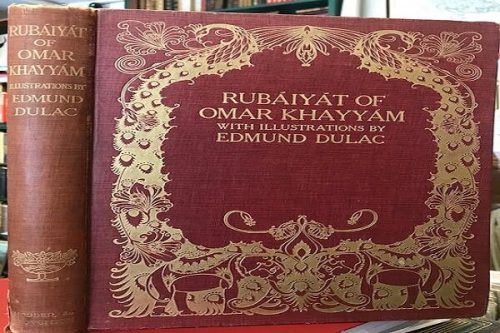

Rubaiyat of Omar Khayyam
Khayyam’s fame as a poet has caused some to forget his scientific achievements which were much more substantial. Versions of the forms and verses used in the Rubaiyat existed in Persian literature before Khayyam, and only about 120 of the verses can be attributed to him with certainty.

The poems celebrated the pleasures of life while illuminating the nuanced political and religious context in which they were created. Of all the verses, the best known is the following:

The Moving Finger writes, and, having writ,

Moves on: nor all thy Piety nor Wit

Shall lure it back to cancel half a Line,

Nor all thy Tears wash out a Word of it.

He also considered himself intellectually to be a student of Avicenna. There are six philosophical papers believed to have been written by Khayyam. Philosophy, jurisprudence, history, mathematics, medicine, and astronomy are among the subjects mastered by this brilliant man.
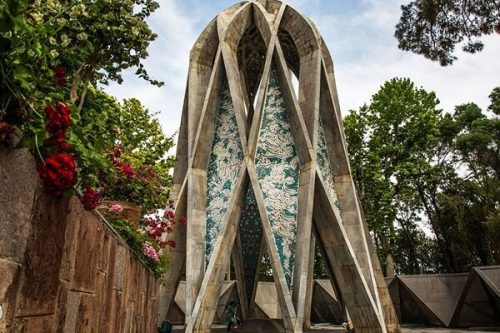

Mausoleum of Omar Khayyam in Nishapur
Khayyam died in Nishapur at the age of 83, on December 4, 1131. His mausoleum is a modern monument of white marble erected over Omar Khayyam’s tomb located in Nishapur. Although the tomb witnessed many calamities, it is not ruined and can host avid tourists from around the world.

In 1934, the reconstruction of the mausoleum was commissioned and Hooshang Seyhoun, who was the supervisor of national monuments constructions with Hossein Jodat, transferred the place of the tomb, and this process continued till 1962. The triangular parts around the tomb are associated with a tent that implies Khayyam’s name.

The Mausoleum of Khayyam is one of the most important buildings of that period in terms of creativity, construction, and architecture. This monument was registered in the list of National Heritage in 1963.
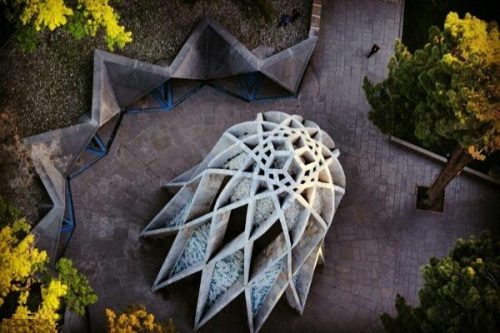

Aerial view of Mausoleum of Omar Khayyam in Nishapur
Ordibehesht 28 in the Persian calendar corresponding with May 18 is the commemoration day of the world-renowned Persian poet, astronomer, and mathematician Omar Khayyam. Every year, a number of literati and scholars from around the world convene at the mausoleum of Khayyam to mark his National Day.

A ceremony is traditionally held on this day in his mausoleum in Nishapur, as well as in many other locations across the country and worldwide.

By: Zahra Mirzafarjouyan

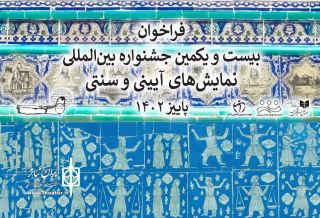
The call for the International Festival of Ritual and Traditional Shows

The call for the 21st International Festival of Ritual and Traditional Shows, which is scheduled to be held this fall, was published. This art event will welcome the works of artists in 9 sections.

According to Iran Teatar, citing the public relations of the General Department of Performing Arts, the headquarters of the 21st International Festival of Ritual and Traditional Shows published the call for this artistic event at the same time as the National Day of Performing Arts and the World Theater Day (April 7, 1402).

The 21st International Festival of Ritual and Traditional Performances will be held in the fall of 1402 under the direction of Ahmed Julayi.

Ritual and traditional festival in 1402 will be held in the following sections:

A) Iranian shows

A1) Special section

A2) Section of free subjects

A3) Student section

b) Mock reading meetings

B1) new councils

B2) strange gatherings

c) Traditional puppet shows

C1) New look/old pattern

C2) The professors’ performance section

e) The department of individual performing arts, impersonations and national narratives and operas

E1) old pattern/new look section

E2) Professors’ performances

f) Battles, rituals and dramatic games

g) Ritual and traditional performances of nations

h) The 9th International Seminar of Ritual and Traditional Shows

i) The fifth playwriting competition

j) Exhibition of Iranian performing arts

Artists interested in participating in this art event should read the festival invitation file attached to this news for more information.

“World War III” wins awards at Vietnam Da Nang Asian Film Festival

Iranian dark comedy “World War III” won the jury award and the best actor award for Mohsen Tanabandeh at the first edition of the Da Nang Asian Film Festival (DANAFF), the organizers announced on Saturday in the Vietnamese city of Da Nang.

Directed by Hooman Seyyedi, the film was Iran’s submission to the 2023 Oscars.

Tanabandeh won the award for his portrayal of Shakib, a homeless day laborer who never got over the loss of his wife and son in an earthquake years ago.

Over the last couple of years, he has developed a relationship with a deaf and mute woman, Ladan. The construction site on which he works today turns out to be the set for a film about the atrocities committed by Hitler during WWII. Against all odds, he is given a movie role, a house and a chance at being somebody. When Ladan learns about this, she comes to his workplace begging for help. Shakib’s scheme to hide her goes tragically wrong and threatens to ruin his newfound status and what seemed to be the opportunity of a lifetime.

Tanabandeh was honored with the Orizzonti Award for best actor at the 79th Venice International Film Festival for “World War III”, which also won the Orizzonti Award for best film.

“Children of the Mist” by Vietnamese director Ha Le Diem was picked as best film at the Da Nang Asian Film Festival.

The documentary takes the viewers to the misty mountains of northern Vietnam, where a Hmong teenage girl faces the challenges of growing up. In Di’s traditional culture, girls marry as early as 14. But at school, she learns there are alternatives.

Kavich Neang from Cambodia won the award for best director for “While Building”, while the best screenplay award was given to “Joyland” by Saim Sadiq from Pakistan.

Co-written by Sadiq and Maggie Briggs, “Joyland” is about the youngest son in a traditional Pakistani family who takes a job as a backup dancer in a Bollywood-style burlesque and quickly becomes infatuated with the strong-willed trans woman who runs the show.

Juliet Bao Ngoc Doling was named best actress for her role in the Vietnamese drama “Glorious Ashes”. /T.T/

Over 200 foreign companies from 13 countries to participate in Iran Oil Show 2023

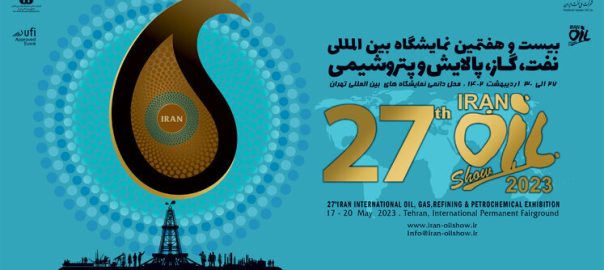
More than 200 Foreign companies from 13 countries are going to participate in the 27th Iran International Oil, Gas, Refining and Petrochemical Exhibition (Iran Oil Show 2023), which is slated to be held at the Tehran Permanent International Fairgrounds during May 17-20.

According to the Director General of the Iranian Oil Ministry’s Office of Public Relations Ali Forouzandeh, the foreign companies participating in the exhibition are from Russia, China, Belarus, Germany, Austria, Italy, France, Spain, India, UAE, Oman, and Turkey.

Forouzandeh said the number of foreign participants in this year’s event has doubled in comparison to the previous year, while the number of Iranian companies that are going to take part in the event has also increased by 35 percent.

100 events have been scheduled to be held during the exhibition, including the signing of memorandums of understanding and contracts between different departments of the Oil Ministry and private companies, 33 side events, 10 specialized knowledge-based meetings, five presentations by the Vice Presidency of Research and Technology, three business forums with Russian companies, three meetings focusing on optimization, as well as the unveiling of a large number of oil industry equipment built by domestic companies. /T.T/

Iran becomes world’s top oil pipeline developer: report

Global Energy Monitor, in a recent report, has said Iran is the world’s top country in terms of oil pipelines under construction. Based on the report, the Iranian Oil Ministry is also among the world’s top oil pipeline developers.

According to new data from Global Energy Monitor, Africa, and West Asia are home to 49 percent of all oil transmission pipelines under construction globally at a cost of $25.3 billion.

The 2023 annual survey of data in the Global Oil Infrastructure Tracker shows that these regions together are building 4,400 kilometers (km) of crude oil transmission pipelines at an estimated capital expenditure of $14.4 billion. An additional 10,800 km are proposed in these regions at an estimated cost of $59.8 billion.

Globally, there are 9,100 km of oil transmission pipelines under construction and an additional 21,900 km of proposed pipelines. These pipelines in development are estimated to cost $131.9 billion in capital expenditure.

The total 31,000 km of oil pipelines in development globally represents an increase of nearly 30 percent from this time last year.

The leading five countries in terms of in-development pipelines (proposed and under construction) are Iran, the United States, India, Iraq, and Tanzania.

The top five parent companies developing oil pipelines are state-owned enterprises and private companies, including Iran’s Oil Ministry, the China National Petroleum Corporation, Iraq’s Ministry of Oil, India’s Numaligarh Refinery Limited, and France’s TotalEnergies.

The longest pipeline projects under construction are the 1,950-km Niger–Benin Oil Pipeline and the Paradip Numaligarh Crude Pipeline (PNCPL) in India, both slated to start operating in 2024. Canada is home to the third-largest pipeline project under construction, the 980-km Trans Mountain Expansion (TMX), expected to start in 2023 as an expansion to the existing Trans Mountain Oil Pipeline. /T.T/

Iranian shooter snatches gold in ISSF World Cup

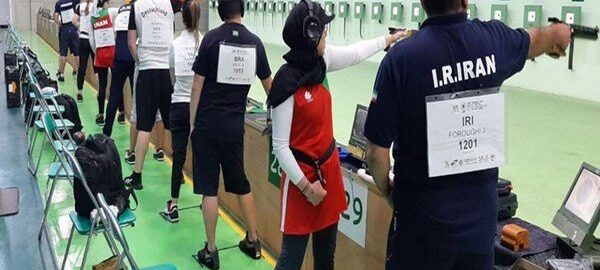
Iranian shooter Sajjad Poorhosseini has bagged a gold medal at the 2023 International Shooting Sport Federation (ISSF) World Cup.

Sajad Poorhosseini ranked first with a total score of 240.2 points in the men’s 10m Air Pistol.

Athletes from Ukraine and Germany received silver and bronze, respectively. Zeinab Toomari in the women’s division was another Iranian representative at the event.

The 2023 ISSF World Cup kicked off in Baku, Azerbaijan on May 8 and will wrap up on May 25. /MNA/


34th edition of TIBF kicks off in Tehran

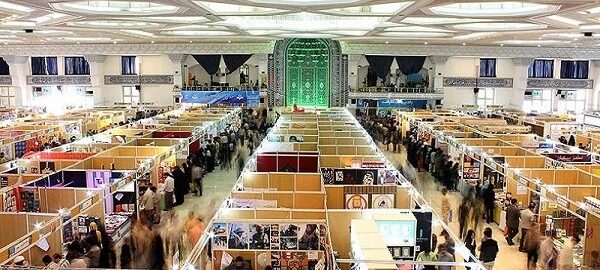
The 34th Tehran International Book Fair (TIBF) was opened in the Iranian Capital at Imam Khomeini’s Grand Mosalla on Wednesday.

Deputy Director of the 34th Tehran International Book Fair, Ali Ramezani said that nearly 100 foreign publishers, 200 booksellers, and 2,700 domestic publishers are active in the virtual and in-person section of the book fair.

Referring to the presence of the directors of Muscat, Doha, and New Delhi Fairs, he added that the ministers of Tajikistan and Venezuela partake in the exhibition.

He noted that Tajikistan is a guest of honor at the Tehran International Book Fair

“The Future Is Readable” is the motto of this year’s book fair.

The 34th Tehran International Book Fair is underway from 20 to 30 May 2023 at Imam Khomeini’s Grand Mosalla. /MNA/

Iranian mathematician shines at Harvard University

After the Iranian genius mathematician Maryam Mirzakhani, Tina Turkman became the second Iranian woman to get Ph.D. in pure mathematics from Harvard University.

Turkman focused his doctoral thesis on Geodesic flows on hyperbolic surfaces under the supervision of Professor Curtis McMullen, winner of the Fields Medal.

She completed her bachelor’s degree in mathematics at Tehran’s Sharif University of Technology in 2017, and in the same year, she was directly accepted to Harvard University’s mathematics doctoral program.

In 2012, Tina Turkman received the gold medal at the National Mathematical Olympiad, and in 2013, she won the silver medal at the World Mathematical Olympiad.

Turkman has the gold medal of the international mathematics competition in 2015, along with a national gold medal and a bronze medal. /MNA/

IRGC tests indigenous rocket with thermobaric warhead

The Islamic Revolution Guards Corps (IRGC) Ground Force has successfully test-launched a domestically-manufactured rocket equipped with a thermobaric warhead.

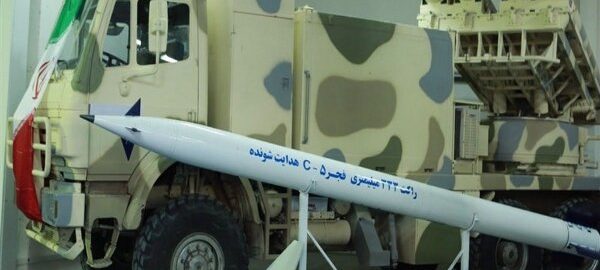
The test of the indigenous Fajr-5 (Dawn-5) rocket with a thermobaric warhead, which operates with a fuel-air explosive (FAE) system, was carried out on Sunday.

Fajr-5 is a 333-mm rocket, whose guided version, known as Fajr-5C, was earlier delivered to the IRGC Ground Force units and is currently furnished with a warhead with more destructive power.

The destructive power of the new thermobaric warhead, which uses oxygen from the surrounding air to generate a high-temperature explosion, is reportedly 1.5 times greater than that of trinitrotoluene (TNT) and enhances the rocket’s blast radius and thermal effect.

The thermobaric explosive’s lower sensitivity than TNT has made it a safer option in comparison with conventional warheads.

Fajr-5 is known as the most advanced and longest-range version of the Fajr ground-to-ground rockets that have various classes with different functions. The 333-mm rocket that runs on solid fuel has single- and two-stage versions, with a range of 75 kilometers and 180 kilometers, respectively.

The new thermobaric warhead’s function would make the Fajr-5 rocket a suitable weapon for the fight against terrorist groups in mountainous and impassable terrain, where terrorists usually construct their shelters and trenches.

Iranian military experts and engineers have in recent years made remarkable breakthroughs in manufacturing a broad range of indigenous equipment, making the armed forces self-sufficient.

Iranian officials have made clear that the country will never bow to pressure to scale down its military programs, including its missile power, which are entirely meant for defense.

MNA/