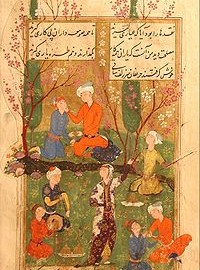
Persian literature spans two and a half millennia, though much of the pre-Islamic material has been lost. Its sources have been within historical Persia including present-day Iran as well as regions of Central Asia where the Persian language has been the national language through history.
As one of the great literatures of mankind the Persian literature has its roots in surviving works in Old Persian or Middle Persian dating back as far as 522 BCE, the date of the earliest surviving Achaemenid inscription, the Bisotun Inscription. The bulk of the surviving Persian literature, however, comes from the times following the Islamic conquest of Persia circa 650 CE. After the Abbasids came to power (750 CE), the Persians became the scribes and bureaucrats of the Islamic empire and, increasingly, also its writers and poets.
Persians wrote both in Persian and Arabic; Persian predominated in later literary circles. Persian poets such as Sa’di, Hafiz , Rumi and Omar Khayyam are well known in the world and have influenced the literature of many countries.
Pre-Islamic Persian literature
Very few literary works survived from ancient Persia. This is partly due to the destruction of the library at Persepolis. Most of what remains consists of the royal inscriptions of Achaemenid kings, particularly Darius I (522–486 BC) and his son Xerxes. Zoroastrian writings mainly were destroyed in the Islamic conquest of Persia. The Parsis who fled to India, however, took with them some of the books of the Zoroastrian canon, including some of the Avesta and ancient commentaries (Zend) thereof. Some works of Sassanid geography and travel also survived albeit in Arabic translations.
No single text devoted to literary criticism has survived from pre-Islamic Persia. However, some essays in Pahlavi such as “Ayin-e name nebeshtan” (Principles of Writing Book) and “Bab-e edteda’I-ye” (Kalileh o Demneh) have been considered as literary criticism (Zarrinkoub, 1959).
Some researchers have quoted the Sho’ubiyye as asserting that the pre-Islamic Persians had books on eloquence, such as ‘Karvand’. No trace remains of such books. There are some indications that some among the Persian elite were familiar with Greek rhetoric and literary criticism (Zarrinkoub, 1947).
Persian literature of the medieval and pre-modern periods
While initially overshadowed by Arabic during the Umayyad and early Abbasid caliphates, New Persian soon became a literary language again of the Central Asian lands. The rebirth of the language in its new form is often accredited to Ferdowsi, Unsuri, Daqiqi, Rudaki, and their generation, as they used pre-Islamic nationalism as a conduit to revive the language and customs of ancient Persia.
In particular, says Ferdowsi himself in his Shahnama:
“For thirty years, I endured much pain and strife,
with Persian I gave the Ajam verve and life”.
Poetry
So strong is the Persian aptitude for versifying everyday expressions that one can encounter poetry in almost every classical work, whether from Persian literature, science, or metaphysics. In short, the ability to write in verse form was a pre-requisite for any scholar. For example, almost half of Avicenna’s medical writings are in verse.
Works of the early era of Persian poetry are characterized by strong court patronage, an extravagance of panegyrics, and what is known as “exalted in style”. The tradition of royal patronage began perhaps under the Sassanid era and carried over through the Abbasid and Samanid courts into every major Persian dynasty. The Qasida was perhaps the most famous form of panegyric used, though quatrains such as those in Omar Khayyam’s Ruba’iyyat are also widely popular.
Khorasani style, whose followers mostly were associated with Greater Khorasan, is characterized by its supercilious diction, dignified tone, and relatively literate language. The chief representatives of this lyricism are Asjadi, Farrukhi Sistani, Unsuri, and Manuchehri. Panegyric masters such as Rudaki were known for their love of nature, their verse abounding with evocative descriptions.
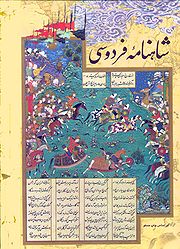
Through these courts and system of patronage emerged the epic style of poetry, with Ferdowsi’s Shahnama at the apex. By glorifying the Iranian historical past in heroic and elevated verses, he and other notables such as Daqiqi and Asadi Tusi presented the “Ajam” with a source of pride and inspiration that has helped preserve a sense of identity for the Iranian peoples over the ages. Ferdowsi set a model to be followed by a host of other poets later on.
The thirteenth century marks the ascendancy of lyric poetry with the consequent development of the ghazal into a major verse form, as well as the rise of mystical and Sufi poetry. This style is often called “Araqi style”, (western provinces of Iran were known as Araq-e-Ajam or Persian Iraq) and is known by its emotional lyric qualities, rich meters, and the relative simplicity of its language. Emotional romantic poetry was not something new however, as works such as Vis o Ramin by Asad Gorgani, and Yusof o Zoleikha by Am’aq Bokharai exemplify. Poets such as Sana’i and Attar (who ostensibly have inspired Rumi), Khaqani Shirvani, Anvari, and Nezami, were highly respected ghazal writers. However, the elite of this school are Rumi, Sadi, and Hafez.
In the didactic genre one can mention Sanai’s Hadiqat-ul-Haqiqah (Garden of Truth) as well as Nezami’s Makhzan-ul-Asrār (Treasury of Secrets). Some of Attar’s works also belong to this genre as do the major works of Rumi, although some tend to classify these in the lyrical type due to their mystical and emotional qualities. In addition, some tend to group Naser Khosrow’s works in this style as well; however the true gem of this genre is Sadi’s Bustan, a heavyweight of Persian literature.
After the fifteenth century, the Indian style of Persian poetry (sometimes also called Isfahani or Safavi styles) took over. This style has its roots in the Timurid era and produced the likes of Amir Khosrow Dehlavi, and Bhai Nand Lal Goya
The most significant essays of this era are Nizami Arudhi Samarqandi’s “Chahār Maqāleh” as well as Zahiriddin Nasr Muhammad Aufi’s anecdote compendium Jawami ul-Hikayat. Shams al-Mo’ali Abol-hasan Ghaboos ibn Wushmgir’s famous work, the Qabus nama (A Mirror for Princes), is a highly esteemed Belles-lettres work of Persian literature. Also highly regarded is Siyasatnama, by Nizam al-Mulk, a famous Persian vizier. Kelileh va Demneh, translated from Indian folk tales, can also be mentioned in this category. It is seen as a collection of adages in Persian literary studies and thus does not convey folkloric notions.
Among the major historical and biographical works in classical Persian, one can mention Abolfazl Beyhaghi’s famous Tarikh-i Beyhaqi, Lubab ul-Albab of Zahiriddin Nasr Muhammad Aufi (which has been regarded as a reliable chronological source by many experts), as well as Ata al-Mulk Juvayni’s famous Tarikh-i Jahangushay-i Juvaini (which spans the Mongolid and Ilkhanid era of Iran). Attar’s Tadkhirat al-Awliya (“Biographies of the Saints”) is also a detailed account of Sufi mystics, which is referenced by many subsequent authors and considered a significant work in mystical hagiography.
The oldest surviving work of Persian literary criticism after the Islamic conquest of Persia is Muqaddame-ye Shahname-ye Abu Mansuri, which was written in the Samanid period. The work deals with the myths and legends of Shahname and is considered the oldest surviving example of Persian prose. It also shows an attempt by the authors to evaluate literary works critically.
One Thousand and One Nights is a medieval folk tale collection which tells the story of Scheherazade, a Sassanid queen who must relate a series of stories to her malevolent husband, King Shahryar (Šahryār), to delay her execution. The stories are told over a period of one thousand and one nights, and every night she ends the story with a suspenseful situation, forcing the King to keep her alive for another day. The individual stories were created over several centuries, by many people from a number of different lands.
The nucleus of the collection is formed by a Pahlavi Sassanid Persian book called Hazār Afsānah (Thousand Myths), a collection of ancient Indian and Persian folk tales.
During the reign of the Abbasid Caliph Harun al-Rashid in the eighth century, Baghdad had become an important cosmopolitan city. Merchants from Persia, China, India, Africa, and Europe were all found in Baghdad. During this time, many of the stories that were originally folk stories are thought to have been collected orally over many years and later compiled into a single book. The compiler and ninth-century translator into Arabic is reputedly the storyteller Abu Abd-Allah Muhammad el-Gahshigar. The frame story of Shahrzad seems to have been added in the fourteenth century.
Compiled By: Firouzeh Mirrazavi
Deputy Editor of Iran Review



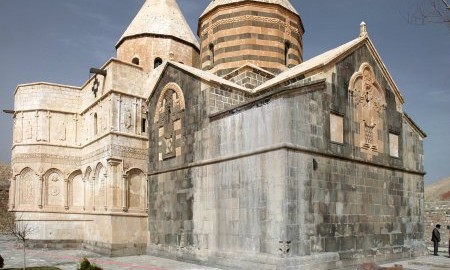



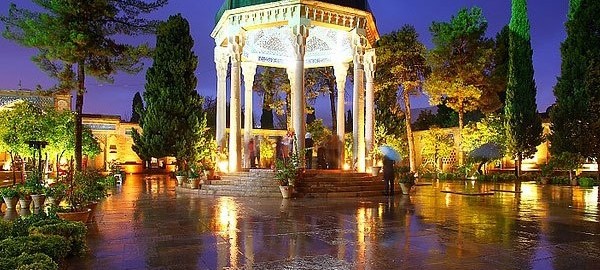
 Today Shiraz is a relaxed, cultivated city, with wide tree-lined avenues and abundant monuments, gardens and mosques to keep most visitors happy for several days. The university here is one of Iran’s finest, and you’ll come across lots of students eager to speak English.
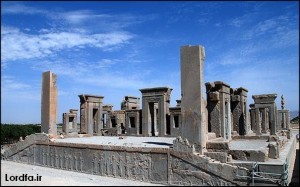 There are plenty of hotels to suit all budgets and tastes in Shiraz, most of them clustered near Zand, the main boulevard. This is also the area to nose out a good feed, from inexpensive kebabs and burgers to more swanky sit-down affairs. Shiraz is nearly 900km (560mi) south of Tehran. It’s a great place to start or finish your trip to Iran and is well serviced by international and domestic flights. The airport lies 8km (5mi) south-east of the city centre. Buses run from Shiraz to Tehran and other major towns; shared taxis run occasionally to Isfahan.