All posts by islam

Iran’s Non-Oil Growth at 4.5% in H1

Iran’s economic growth during the first half of the current fiscal year (started March 20), excluding the oil sector, stood at 4.5%, the government spokesman and president of Planning and Budget Organization, Mohammad Baqer Nobakht, said on Monday.

“Including the oil output, the GDP growth stood at 6.5%,” he was quoted as saying by Mehr News Agency.

Nobakht said the growth’s details for the six months will be published in the coming days.

His statements come after the Central Bank of Iran reported earlier this month that the gross domestic product during this period grew 7.4% compared with last year’s corresponding period.

The CBI report added that most of the growth came from the oil sector.

Iran’s oil production increased by 18.8% to 3.92 million barrels per day during January-September 2016, the US Energy Information Agency reported on Friday.

According to the report, Iran’s oil output, including gas condensates, stood at 4.170 million bpd in September, about 20,000 bpd more than November and 870,000 bpd more than September 2015.

Iran’s September oil production was the highest since the late 1980s, the report said.

Iran aims to lift output to 5 million barrels a day within two or three years—at least 1.3 million barrels a day above what it was in 2010, the year before international sanctions were introduced.

The International Monetary Fund forecasts that Iran’s real GDP will grow by at least 4.5% in 2016-17.

The World Bank forecasts 4.2% and 4.6% growth rates for Iran’s economy for 2016 and 2017 respectively.

The government has set an 8% annual growth target for the sixth five-year development plan (2016-21).

/ Financial tribune /

Iran Nanoscience Ranking Improves

Iran has been placed 6th in the latest world ranking for nanoscience production, the founder of the Islamic World Science Citation Database (ISC) said on Saturday.

According to Jafar Mehrdad, the statistics on nanoscience and nanotechnology for both global and regional rankings were published December 2016. The figures include the number of nanotechnology articles published in indexed journals as announced by Thomson Reuters.

“The number of papers Iran published on nanotechnology was 6,697 in 2015. It reached 70,045 by November 2016,” Mehr News Agency quoted him as saying.

The latest ranking in nanoscience production places Iran after China, US, India, South Korea, and German, respectively.

Iran beat Japan, France and UK in the ranking.

/ Financial tribune /

Persepolis interested in Nigerian striker Mensha

Persepolis football team is interested in signing Paykan striker Gowdin Mensha.

Persepolis striker Mehdi Taremi has been linked with a move to Greek side AEK Athens in the transfer window.

Iran Professional League (IPL) pacesetter needs to strengthen the attacking line since the team will start its campaign in the AFC Champions League from February.

The 27-year-old Nigerian striker has scored six goals in 12 matches for Paykan.

Paykan football club has not officially received a request so far, the Tehran-based team said./ Tehran times /

Iran resumes carpet exports to US in post-sanctions era

Head of the Iranian National Carpet Center has announced the resumption of Iran’s hand-woven carpet export to the US during post-sanctions era.

Hamid Karegar, speaking in a meeting with Qazvin Governor General Fereidoun Hemmati on Sunday, said that Iran resumed carpet exports to the US in the wake of the Joint Comprehensive Plan of Action (JCPOA).

“Carpet exports to the US in the eight months of the current Iranian year was set on $50 million compared to zero in the previous year,” he underlined.

Kargar stated that Iranian carpet exporters have not been present in American market for five years as a result of which Indian carpets have taken the place of Iranian rugs.

He further emphasized that before the imposition of international sanctions against Iranian carpets in 2010, the US remained as the top importer of Persian Carpet with a share of more than 16.5 per cent worth 82 million dollars.

Noting that carpet exports to China have also increased in recent years, Karegar said that over the past five years, carpet exports to China has raised to eight million dollars from previous 8000 dollars.

Sanctions on the country’s carpet industry imposed negative impacts on its exports, Kargar said, adding after JCPOA we have seen openings in sales of Iranian goods to the customers in foreign countries.

Iran’s carpet industry dates back to 3,000 years ago and currently, one million artists are engaged in the industry, Karegar noted. / meher news /

Iran set to stage military exercise in southern provinces

Iran’s military will start a five-day military drill in southern areas where the Bushehr nuclear plant is located, Farzad Esmaieli, commander of the Khatam al-Anbia Air Defense Base, announced on Sunday.

The annual maneuver, called Modafean-e Aseman-e Velayat-e 7 (defenders of the sky of Velayat-e 7), will start on Monday in three provinces of Khuzestan, Hormozgan, and Bushehr.

In addition to regular army forces, divisions from the Islamic Revolutionary Guards Corps and Basij will participate in the war game, in an effort to create more coordination among different parts of the country’s integrated air defense network, the commander explained.

“Upwards of 17,000 personnel of the Armed Forces will participate in Modafean-e Aseman-e Velayat-e 7 either directly or indirectly,” Esmaieli told a press conference in Bushehr.

Staged in an area of 496,000 km2, the war game will cover parts of the Sea of Oman and the Persian Gulf as well as the three islands of the Greater Tunb, Lesser Tunb and Abu Musa.

A wide gamut of air defense systems, including radars, anti-missile defense units, law-, medium- and high-altitude missiles, and surveillance equipment will be used in the drills, Esmaieli said.

All heavy and light equipment used in the maneuver are homegrown, the commander said, adding the S-300 air-defense system will not be deployed.

Instead of the Russian air-defense system, Iran is likely to utilize its first vertical-launching air defense system, Bavar-373 (Belief 373), developed as a possible alternative to the Russian system.

Parts of the system were put on display in an exhibition held on the occasion of National Defense Industry Day, which fell on August 21 this year.

Also, the Fakour Command Post which Iran unveiled in 2015 will be field-tested, according to Esmaieli.

/ Tehran times/

Iran oil production increases by nearly 19% in 9 months

Iran’s oil production increased by 18.8 percent in the first nine months of 2016, reaching 3.92 million barrels per day (mb/d), the US Energy Information Agency (EIA) says.

Iran’s oil output, including gas condensate, stood at 4.170 mb/d in September, about 870,000 b/d more than September 2015, the EIA said in a report.

It added that Iran’s oil production in September was the highest since late 1980s.

The Organization of the Petroleum Exporting Countries (OPEC) said Iran’s oil production reached a new record high of 3.665 million barrels per day (mb/d) in September.

Iran has announced that it produced over 560,000 b/d of gas condensate in September.

Iran is presently OPEC’s third largest producer after Saudi Arabia and Iraq.

It has repeatedly announced that Iran plans to increase its oil production to as high as four mb/d, the level that existed before US-led sanctions imposed against Tehran in 2011.

The sanctions mainly prevented foreign investments in Iran’s oil industry that it needed for its oil production. They also restricted the country’s oil exports to around one mb/d.

Iran and the five permanent members of the United Nations Security Council – the United States, France, Britain, Russia and China plus Germany signed a nuclear agreement on July 14, 2015, under which Iran undertook to put limitations on its nuclear program in exchange for the removal of nuclear-related sanctions imposed against Tehran. / press tv /

In focus: Jameh Mosque of Ardestan

The Jameh Mosque of Ardestan, in central Iran, is of high historical importance as it incorporates successive architectural styles of the Sassanids, Buyids, Seljuks and Safavids.

However, a majority of what visitors to the mosque see dates form the Seljuk era (ca. 1040–1196).

Located in a city of the same name in Isfahan Province, the two-story hypostyle mosque has a four- portico (iwan) courtyard surrounded by encircling arcades.

The mosque is part of a larger premises that also includes other mudbrick structures such as a cistern, a caravanserai, a marketplace, a bathhouse, and a madrasa.

According to Isfahan Cultural Heritage, Tourism, and Handicrafts Department, the mosque was inscribed on the national heritage list in 1931.

Jameh means congregational. / Tehran times /

Famous Persian poet Saadi Shirazi

Saadi Shirazi Saadi was born in Shiraz around 1200. He died in Shiraz around 1292. He lost his father in early childhood. With the help of his uncle, Saadi completed his early education in Shiraz. Later he was sent to study in Baghdad at the renowned Nezamiyeh College, where he acquired the traditional learning of Islam.

The unsettled conditions following the Mongol invasion of Persia led him to wander abroad through Anatolia, Syria, Egypt, and Iraq. He also refers in his work to travels in India and Central Asia. Saadi is very much like Marco Polo who traveled in the region from 1271 to 1294. There is a difference, however, between the two. While Marco Polo gravitated to the potentates and the good life, Saadi mingled with the ordinary survivors of the Mongol holocaust. He sat in remote teahouses late into the night and exchanged views with merchants, farmers, preachers, wayfarers, thieves, and Sufi mendicants. For twenty years or more, he continued the same schedule of preaching, advising, learning, honing his sermons, and polishing them into gems illuminating the wisdom and foibles of his people.

When he reappeared in his native Shiraz he was an elderly man. Shiraz, under Atabak Abubakr Sa’d ibn Zangy (1231-60) was enjoying an era of relative tranquility. Saadi was not only welcomed to the city but was respected highly by the ruler and enumerated among the greats of the province. In response, Saadi took his nom de plume from the name of the local prince, Sa’d ibn Zangi, and composed some of his most delightful panegyrics as an initial gesture of gratitude in praise of the ruling house and placed them at the beginning of his Bostan. He seems to have spent the rest of his life in Shiraz.

His best known works are the Bostan (The Orchard) and the Golestan (The Rose Garden). The Bostan is entirely in verse (epic metre) and consists of stories aptly illustrating the standard virtues recommended to Muslims (justice, liberality, modesty, contentment) as well as of reflections on the behaviour of dervishes and their ecstatic practices. The Golestan is mainly in prose and contains stories and personal anecdotes. The text is interspersed with a variety of short poems, containing aphorisms, advice, and humorous reflections. Saadi demonstrates a profound awareness of the absurdity of human existence. The fate of those who depend on the changeable moods of kings is contrasted with the freedom of the dervishes.

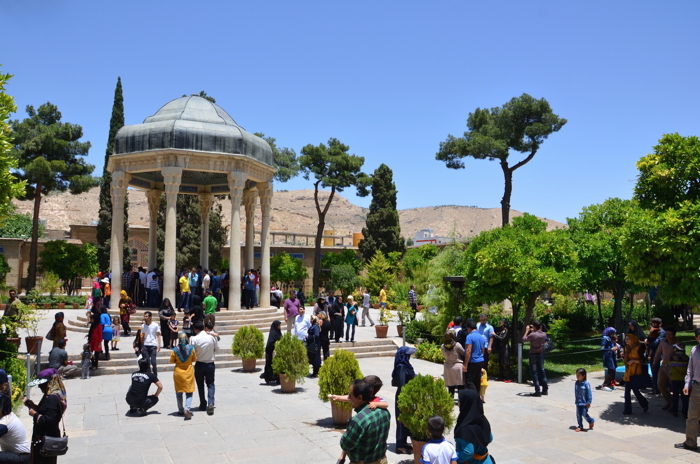
Tomb of Saadi in Shiraz For Western students the Bostan and Golestan have a special attraction; but Saadi is also remembered as a great panegyrist and lyricist, the author of a number of masterly general odes portraying human experience, and also of particular odes such as the lament on the fall of Baghdad after the Mongol invasion in 1258. His lyrics are to be found in Ghazaliyat (“Lyrics”) and his odes in Qasa’id (“Odes”). He is also known for a number of works in Arabic. The peculiar blend of human kindness and cynicism, humour, and resignation displayed in Saadi’s works, together with a tendency to avoid the hard dilemma, make him, to many, the most typical and lovable writer in the world of Iranian culture.

Saadi distinguished between the spiritual and the practical or mundane aspects of life. In his Bostan, for example, spiritual Saadi uses the mundane world as a spring board to propel himself beyond the earthly realms. The images in Bostan are delicate in nature and soothing. In the Golestan, on the other hand, mundane Saadi lowers the spiritual to touch the heart of his fellow wayfarers. Here the images are graphic and, thanks to Saadi’s dexterity, remain concrete in the reader’s mind. Realistically, too, there is a ring of truth in the division. The Shaykh preaching in the Khaniqah experiences a totally different world than the merchant passing through a town. The unique thing about Saadi is that he embodies both the Sufi Shaykh and the traveling merchant. They are, as he himself puts it, two almond kernels in the same shell.

Saadi’s prose style, described as “simple but impossible to imitate” flows quite naturally and effortlessly. Its simplicity, however, is grounded in a semantic web consisting of synonymy, homophony, and oxymoron buttressed by internal rhythm and external rhyme. Iranian authors over the years have failed to imitate its style in their own language, how can foreigners translate it into their own language, no matter what language?

The world honors Saadi today by gracing the entrance to the Hall of Nations in New York with this call for breaking all barriers:

Of one Essence is the human race,

Thusly has Creation put the Base;

One Limb impacted is sufficient,

For all Others to feel the Mace.


/ Iran chamber society /

Khaseb stages “Mud” in Bangladesh

The Iranian theater troupe Crazy Body led by director Yasser Khaseb performed “Mud” on the closing day of the 2nd edition of the BotTala Rangamela, a local theater festival, which was held in Dhaka, Bangladesh from December 1 to 10.

In the play Khaseb’s co-performer Hamid Etemedi, in the role of a sculptor, forms Khaseb out of mud. Caked in dirt, Khaseb is poured from a barrel and shaped, and ultimately asserts himself before the artist. /  Tehran times /

Telepizza will invest €100 million in Iran

Telepizza, the leading pizza restaurant chain based in Spain, has announced its planned arrival in Iran as of March 2017 via a strategic master franchise alliance with its partner Momenin Investment Group and the objective of 200 stores in 10 years.

This will mean opening some 20 establishments per year and an investment of €100 million in 10 years by MIG, PR Newswire reported.

The first store will be founded in the capital Tehran, after which seven others will be opened before the end of the year.

“The arrival of Telepizza in Iran is a major accomplishment in our international expansion and represents a great opportunity for our business. We are delighted to share the essence of our brand, nothing less than offering pizza with a unique flavor at any time or place, with Iranian consumers,” says Pablo Juantegui, chairman and CEO of Telepizza.

“We are very satisfied to have found a travel companion like Momenin Investment Group to begin our venture in Iran, which promises to be very interesting. We will be the first European chain in the QSR (quick service restaurants) segment to set up in this country, catering to the customers’ demand that went unmet up to this point,” says Giorgio Minardi, international chairman of Telepizza.

Since its arrival in Chile in 1992, Telepizza’s international expansion has not yet stopped: 1,342 shops (456 company-owned and 886 franchisees and master franchises) are operating in 15 countries in Europe, Asia, Africa and Latin America, offering its products to more than 60 million customers with total sales of €506 million per annum.

The company also has its own factories in six countries (Spain, Portugal, Poland, Chile, Columbia and Peru) as well as master franchise factories in six additional territories: Saudi Arabia, the UAE, Central America, Russia, Bolivia, and Angola; and also has partner warehouses in Ecuador and Poland.

Telepizza is listed on the Barcelona, Bilbao, Madrid and Valencia stock exchanges. Its shares started trading on April 27, 2016. The total number of shares is 100,720,679.

Several international brands in the food industry have taken advantage of the opening up of Iran’s economy. Croatian franchise Surf’n’Fries expanded its business operations to Iran earlier this year. Surf’n’Fries was founded in 2009 with the first sales outlet opened in the Croatian port city of Rijeka.

At present, the franchise is also operating in Germany, Austria, Slovenia, Hungary, Romania, Bosnia and Herzegovina, Montenegro, Macedonia and Vietnam. It boasts the SURFFRY technology, using moisture from potatoes and hot air which, at 250 degrees Celsius, makes fries without using oil in just a few minutes.

Last month, Yum! Brands announced that it managed to secure the required licenses to set up business in Iran.

“The corporation aims to launch close to 300 branches in Iran within the next three years. The first branch will be opened in Tehran’s Andarzgou Boulevard in about a month,” said Ali Shabani, the legal director of Z.K.D. Corporation, the representative of the American brand in Iran, marketed as “Burger Sun by Yum”.

Yum! Brands, based in Louisville, Kentucky, has more than 43,000 restaurants in about 140 countries and territories. The company’s restaurant brands KFC, Pizza Hut and Taco Bell are the global leaders of the chicken, pizza and Mexican-style food categories.

It is estimated that one-third of Iranian spending at restaurants is concentrated on the fast food sector with Iranian families currently spending $2 billion annually on fast food (about $85 per family), according to a report by Tehran-based management consulting firm ILIA Corporation

Wealthy Iranians (the tenth decile) spending on restaurants is 41 times more than the first decile ($1,300 versus $31 per year), the report added.

It is estimated that 20,000 fast food establishments are operating in Iran, predominately in Tehran. There is also a large prevalence in the next four largest cities, namely Shiraz, Isfahan, Mashhad and Tabriz.

/ Financial tribune /