All posts by islam

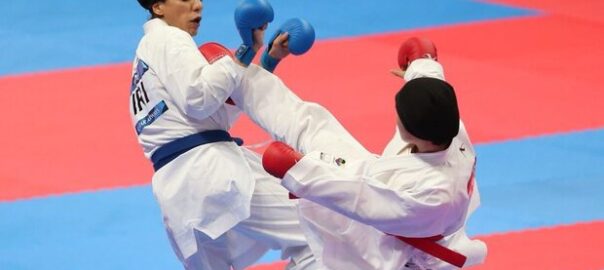
Iran stands at top of Asian karate championships

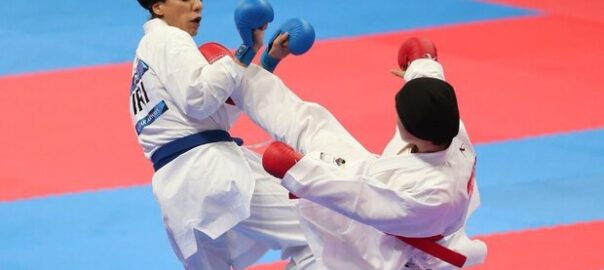
Iranian karate teams at different age groups have won the title of the 19th edition of the Asian Karate Championships 2021 in Kazakhstan.

On the final day of the Asian Karate Championships, the Iranian representatives added one gold and three silver medals in the individual division to Iran’s tally.

The Iranian karate practitioner at different age groups at cadets, juniors, U23 and seniors in both kata and kumite collected 39 medals.

Iran won an overall of 14 gold, 14 silver and 15 bronze medals to become the champions with a total of 39 medals.

The host country Kazakhstan became vice-champion with 32 medals, followed by Japan in third place with a total of 10 medals. /MNA/

Iranian celebrations, music festival one step closer to UNESCO register

Iranian celebrations and festivities of Yalda, Chaharshanbeh-Suri, Mehregan, and Sadeh as well Regional Music Festival of the country are closer to being inscribed on UNESCO’s Intangible Heritage list, ISNA reported on Wednesday.

The reason behind this is their recent registration on the List of Intangible Cultural Heritage alongside the Silk Roads, which significantly paves the way for becoming UNESCO listed in the future, the report added.

Registration for these festivals took place at an online world summit hosted by the International Information and Networking Centre for Intangible Cultural Heritage in the Asia-Pacific Region under the auspices of UNESCO (ICHCAP) in South Korea, and the International Institute for Central Asian Studies (IICAS) in Samarkand on December 10.

The Regional Music Festival of Iran was selected as the only music festival at the meeting.

The festival, which has been held regularly for 14 years, brings together dozens of different types of Iranian music, such as Kurdish, Lori, Bakhtiari, Turkmen, Baluchi, Qashqai, Khorasani, Gilaki, Mazandarani, and others.

The diversity of Iranian instruments and music, and the possibility of establishing cultural exchanges with neighboring countries through regional music are just a few of the important factors that Iran presented for inscribing this festival as a World Heritage.

Yalda

Yalda (the birth of a new sun) and Noruz or Persian New Year (the birth of a new day) are amongst the most popular ancient Persian festivals, which are also celebrated by some countries in western and central Asia.

Also called, Yalda Night, the occasion is celebrated on the eve of the winter solstice, which falls on the last day of Azar (the last month of autumn in the Iranian calendar year). On that graceful night, the winter chill is vanquished and the warmth of love embraces the entire family. It’s a time for pleasant family reunions that entails laughter, merriment, and good cheer.

According to the UNESCO website, Yalda ceremonies, in the best way, point to cultural diversity and human creativity, especially when one considers the wide range of the communities that celebrate it.

Chaharshanbeh-Suri

As every last Tuesday of the Iranian calendar year comes, millions of Iranians make bonfires at sunset to jump over the fire till midnight to observe Chaharshanbe-Suri, just days before Noruz, the New Year holidays.

The festival is held on the night before the last Wednesday of the year when families and friends gather by bunches of open fires and keep them lit till dawn.

Narratives say that ancient Iranians originally observed such time-honored fire festivity in a bid to ward off all the misfortunes and bad omens with hopes that their wishes would come true.

In ancient Persia, the fire was considered a sacred element, a belief that modern Zoroastrians still adhere to. The fire has been supposed to give people its warmth and energy and take away their paleness, sickness, and problems in return.

Mehregan

Meheregan, the largest Iranian festival after Noruz, marks the autumnal equinox when day and night are equal and it dates back to ancient times when the start of autumn brought the start of the new year.

Mehregan typically brings together clusters of Iranian Zoroastrians in celebration of Mithra, an ancient goddess of friendship, affection, and love. The celebrations are usually opened up with keynote speeches by Zoroastrian religious figures and officials, followed by Shahnameh recitations, exciting contests, and other joyful customaries.

A key feature for the event is large spreads in purple laden with various ingredients, dishes, and elements each on behalf of a particular belief. Fruits, vegetables, dried nuts, sweets, rosewater, grilled lamb meat, lotus seeds, and silver coins, and a scale are typically placed, the latter symbolizes autumnal equinox.

Mehregan falls on the 196th day of the Iranian calendar year that usually equals October 2 in the Gregorian calendar. The festivity was used to be a traditional autumn harvest festival with several accounts of its origins.

Sadeh

Jashn-e Sadeh, which usually falls on January 30, is named after the number one hundred (Sad in Farsi). The event marks 50 days and 50 nights before Noruz (the beginning of the Iranian calendar year on March 21). The common belief emphasizes that it is a mid-winter ritual to celebrate the date when the earth starts warming up.

The festivity is nowadays more popular among Iranian Zoroastrians in the cities of Yazd, Tehran, Shiraz, and Kerman. Narratives say that the feast is to remember the mythical discovery of fire. That’s why they set fire to a big pile of wood when the event reaches its climax.

The origins of the festival are somewhat ambiguous and there is no trace of this ceremony in the Zoroastrian holy texts. However, some historians suggest the ceremony existed even before Zoroastrianism, the world’s oldest monotheistic religion.

Some say Sadeh is a festivity to honor fire and to defeat the forces of darkness, frost, and cold. Several mythological accounts, however, connect the festival to the origins of human beings. According to Persian mythology, Houshang, the second king of the world, discovered the fire when he tried to hit a dragon with a stone. He reportedly threw a flintstone that struck against another flint stone causing a spark and generating fire.

The time-honored Zoroastrian rituals are widespread in Iran. Noruz, Yalda Night -which takes place on the longest night of the year, and Chaharshanbeh Souri – in praise of the spring, are examples of such ceremonies that even nowadays nearly all Iranians observe. /T.T/


Iran ranks 1st in neuroscience field in region

Advisor to the Iranian Cognitive Sciences & Technologies Council said Saturday that Iran ranked first in the region in the field of neuroscience and cognitive neurology.

Mohammad Taghi Joghataei said that based on the study and assessment carried out by international organizations, Iran ranks first in neuroscience and cognitive neurology in the region.

He also added that Iran currently ranks 19th in the world in the field of neuroscience, 13th in behavioral neuroscience, 17th in the cellular and molecular field and 12th in artificial intelligence and neuroscience.

Joghataei, who is also the President of the Iranian Neuroscience Society (INSS), stated that the 10th Neuroscience Congress 2021 is slated to be held on Dec 22-24, 2021 virtually in Tehran.

He underlined that the 10th Neuroscience Congress 2021 will focus on brain mapping, computational neuroscience, epilepsy, brain stimulation, neurotechnology, brain damage disorders, neurogenetics, cognitive rehabilitation in the elderly and coronary heart disease and its impact on the nervous system.

During the conference, which will be participated by Iran, Turkey and Georgia, two specialized panels of regional associations on neuroscience will be held as well, he added.

Joghataei underlined that all the speeches and articles submitted to the congress will be presented virtually. /MNA/


Iranian students win India’s intl. innovation competition

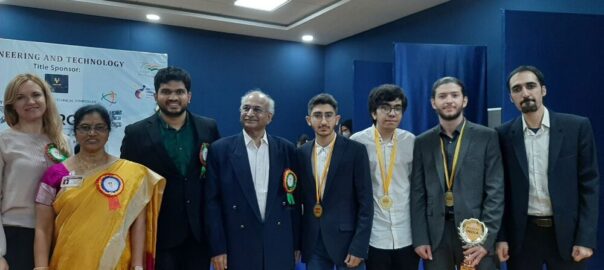
Iranian students grabbed 3 gold medals in electronics, artificial intelligence, and programming at the India International Innovation and Invention Expo (INEX 2021), IRNA reported on Monday.

Mehrbod Bani-Amerian and Arvin Yaghoubi won the gold medals and the special prize of the competition. A team consisting of Behnam Karimi and Alireza Jafari was the other gold medal winner.

Hassan Kakanejadi and Koosha Rostami also won a gold medal in this competition.

Held on December 13 to 16, the INEX 2021 is planned to be organized in Hyderabad, India under IFIA’s patronage.

This competition is held every year with the support of the World Federation of Inventors and the Intellectual Property Organization, in cooperation with the Inventors Organization of India, and this year was held in person and online with the participation of students from 30 countries.

Rapid development of innovation

Knowledge-based companies and creative startups have grown over the past five years, and Iran has risen 45 places in the Global Innovation Index, according to the UNESCO 2021 Report.

The Global Innovation Index in Iran from 2015 to 2019 has risen from 106 to 61 with continuous improvement, showing 45 steps growth.

The development of accelerators and innovation centers over the last five years has led to a rapid increase in startups and knowledge-based companies.

Between 2014 and 2017, exports of knowledge-based goods grew by a factor of five, before slumping in 2018 after the U.S. withdrew from the Joint Comprehensive Plan of Action (2015), commonly referred to as the nuclear deal, and re-imposed sanctions.

The report states that innovation in Iran has developed rapidly over the past five years, and by the end of last year, 49 accelerators and 113 innovation centers had provided services to start-ups with the participation of the private sector. /MNA/

Iranian karatekas add 6 bronzes to tally at Asian event

Iranian karate practitioners added 6 more bronze medals to Iran’s tally on the fourt day of the 19th edition of the Asian Karate Championships 2021 in Kazakhstan.

The 2021 Asian Karate Championships in all age categories (cadets, juniors, U23 and seniors) in kata and kumite started on Saturday morning in Almaty, Kazakhstan.

At the end of the fourth day of event, the Iranian karate practitioners added 6 bronze medals to Iran’s tally to help their country still remain at the top with a total of 32 medals so far.

Iranians have so far won 13 gold, 5 silver and 14 bronze medals to stand at the top of the table of competition at the end of the fourth day, followed by Khazkhestan with 27 medals and Kuwait with 12 medals.

The 2021 Asian Karate Championships are the 17th edition of the Senior Asian Karate Championship and 19th edition of the Cadet, Junior & U21 Championships and are being held in Almaty, Kazakhstan from 19 to 22, December 2021. /MNA/

Yalda Night, celebration of longest night of year

Every year, on 30 Azar in the Iranian calendar that falls on December 21 this year, Iranians celebrate the arrival of winter, the renewal of the sun and the victory of light over darkness on Yalda Night.

An ancient Iranian festival that basically celebrates the coming of the winter solstice and the longest night of the year for centuries is Yalda Night (or Shab-e Yalda; also, Shab-e Chelleh). It refers to a time between the sunset of autumn’s last day (30th of Azar in Iranian calendar equal to 21st of December) and the sunrise of the first day of winter (1st of Dey in Iranian calendar equal to 22nd of December).

It is considered as one of the holy nights and one of the most important festivities in ancient Iran and officially entered the official calendar of the ancient Iranians from 502 BC during the time of Darius I, commonly known as Darius the Great.

Yalda Night, both before and after Islam, has a special place in Iranian culture and has always been considered a motivation for gathering close and distant relatives. The festivities that take place on this night are an ancient tradition.

Since days get longer and nights get shorter in winter, Iranians celebrate the last night of autumn as the renewal of the sun and the victory of light over darkness.

Yalda Night, celebration of longest night of year

Yalda night is a long-standing tradition that has long been considered important by Iranians. In ancient times, darkness was considered a sign of the devil, so on in the night of Yalda, which is the longest night of the year, the Iranians lit fires to protect themselves from evil forces due to the light of fires.

Like Iran, central Asian countries, including Afghanistan, Uzbekistan, Turkmenistan, Tajikistan and some Caucasian states like Azerbaijan and Armenia, and some parts of Pakistan, India and Kashmir share the same tradition, celebrate Yalda Night.

Iranians’ traditions and customs on Yalda night are different from other countries. On the eve of Yalda Night, indescribable passion arises among Iranian families as they want to prepare themselves for this night.

Yalda Night, celebration of longest night of year
A family sits on the floor around the Korsi during the ‘Yalda Night’ celebration
Yalda Night customs have not changed much over time.

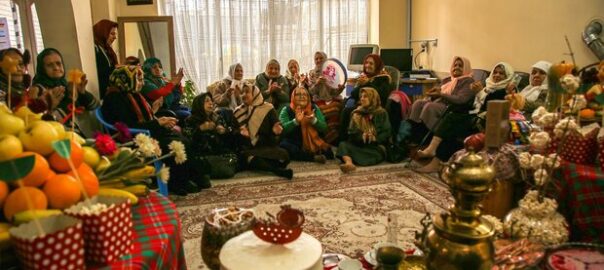
If we review the history of Yalda, we can find that in ancient times people used to gather around the fire and celebrate the night. Around the past thirty or forty years, Iranians used to sit around a Korsi (a type of low table found in Iran, with a heater underneath it, and blankets thrown over it), and nowadays, people are using heaters and other kinds of heating devices in their houses. Yalda is now celebrated by Iranians in a form of overnight family gatherings.

On Yalda Night, people gather in groups of friends or relatives usually at the home of grandparents or the elderly to celebrate the longest night of the year. As storytelling is an entertaining tradition of Yalda Night, the elders entertain the others by telling them tales and anecdotes.

Reading Shahnameh and poems from Divan-e-Hafiz is the other Iranian tradition in this ancient Iranian festival. Each of the members of a family or a group of friends makes a wish-while keeping it a secret- and randomly opens the Divan-e-Hafiz; then the eldest member of the family or friends reads the randomly selected poem loudly. Since the poem is believed to be the interpretation of the wish and the way it would come true, it is fun to interpret the poem and guess the wishes others make.

Yalda Night, celebration of longest night of year
People in Sanandaj, Kordestan province of Iran getting ready for ‘Yalda Night’
One of the most attractive rituals of Yalda night is its foods, fruits, and snacks.

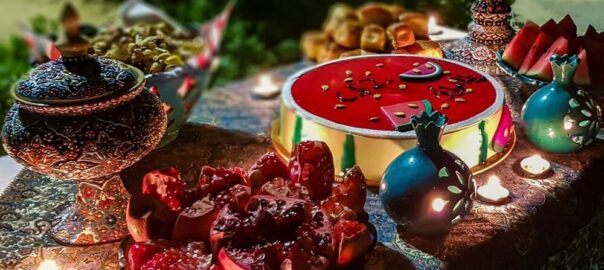
Iranian families usually prepare a sumptuous dinner as well as buy nuts and a variety of fruits, most commonly watermelon and pomegranate. Every city and culture considers special food to celebrate Yalda night.

Fruits, especially red fruits play important role in Yalda’s delicious part. The red color of these fruits is a symbol of the sun.

Yalda Night, celebration of longest night of year
Pomegranate main fruit of ‘Yalda Night’
Pomegranate is the main fruit of Yalda Night. The ancients considered pomegranate to be the fruit of fertility and blessing. Pomegranate is also considered as a symbol of happiness and the sun because of its red color. It has been known as a sacred fruit since ancient times.

Watermelon, like pomegranate, is a special fruit for Yalda Night. But isn’t it weird to eat watermelon on a cold day?

We all know that watermelon is a summer fruit; so watermelon, in addition to its red color, is a symbol of the sun and reminiscent of summer heat. It was believed that if they eat some watermelon this night, they will be safe from cold and disease throughout the winter.

Other Yalda fruits include autumn fruits. Fruits such as oranges and citrus fruits, apples, persimmons, pears and even pumpkin were also used in Yalda Night.

On this night, snacks and nuts for Yalda night are more important than dinner. Nuts such as pistachios, walnuts, almonds and hazelnuts are the main components of nuts for Yalda night. Dried figs and berries are also can be seen among the delicious part of this night.

Yalda Night, celebration of longest night of year
‘Yalda Night’ celebrations in Iran
Yalda Night ritual is held in different cities of Iran based on the city’s culture and geography, each of which has its own charms; However, some of them have been forgotten and only a memory of them remains.

An old custom still rehearsed in eastern parts of the country (Khorasan) is the preparation and consumption of “Kaf”, which is a sort of sweet that looks like foam. Another custom of specific parts of Iran and Khorasan on the night of Chelleh is related to young engaged couples.

Another ceremony that was held this night in Khorasan was the ceremony of Shahnameh, where elders of the party were engaged in songwriting and reading Shahnameh.

In Tabriz, street musicians are known as “Ashiq” walk around neighborhoods while singing, playing music, telling legends and stories.

The beauty of Yalda in the Lorestan Area starts right after the sunset when young people would go on the neighbors’ rooftops and start singing the “Shov-e Avval-e Qāreh” song, where they would hang a scarf from the rooftop of the neighbor’s house, asking them for treats.

Yalda Night, celebration of longest night of year
‘Yalda’ celebration ceremony in Day Care Center in Bojnourd
Zanjan is among the few places where ‘Korsi’ has still practical usage; and wherever there is a Korsi, there will be a memorable gathering. On Yalda, local people serve their own local sweets including the famous window-shaped pastries and baklava.

In Sanandaj, the capital of Kordestan Province, dolma and sangak bread is prepared for Yalda. Each year, as agreed between the families, the ceremony takes place in a different house.

As Yalda Night and its traditions are so interesting, it was officially added to Iran’s List of National Treasures during a special ceremony in 2008.

This year, due to the global epidemic of coronavirus, a different situation prevails for all families on Yalda night.

In this regard, the authorities have asked the people to hold the ceremony differently this year and to refrain from going to each other’s houses in order to prevent further transmission of the coronavirus.

Iranian people have been also advised to stay at their homes and celebrate this ritual virtually this year through voice and video calls. /MNA/


Iranian karatekas add 6 bronzes to tally at Asian event

Iranian karate practitioners added 6 more bronze medals to Iran’s tally on the fourt day of the 19th edition of the Asian Karate Championships 2021 in Kazakhstan.

The 2021 Asian Karate Championships in all age categories (cadets, juniors, U23 and seniors) in kata and kumite started on Saturday morning in Almaty, Kazakhstan.

At the end of the fourth day of event, the Iranian karate practitioners added 6 bronze medals to Iran’s tally to help their country still remain at the top with a total of 32 medals so far.

Iranians have so far won 13 gold, 5 silver and 14 bronze medals to stand at the top of the table of competition at the end of the fourth day, followed by Khazkhestan with 27 medals and Kuwait with 12 medals.

The 2021 Asian Karate Championships are the 17th edition of the Senior Asian Karate Championship and 19th edition of the Cadet, Junior & U21 Championships and are being held in Almaty, Kazakhstan from 19 to 22, December 2021. /MNA/

Iran wins several medals on 2nd day of Asian Karate C’ships

Iranian karate practitioners won 8 different medals on the second day of the 19th edition of the Asian Karate Championships 2021 in Kazakhstan.

On the second day of the 19th edition of the Asian Karate Championships 2021 hosted by Kazakhstan, Iranian Karate practitioners bagged 3 gold, 2 silver and 3 bronze medals for their country.

Today Iranian female Karate practitioners shone in the competitions while the Iranian male junior team displayed very poor performance. The Iranian Kata Kumite in the men’s division only won two bronze medals.

The KATA practitioners of the U21 and Kumite PR practitioners U19 competed Sunday on the second day of these competitions in which the Iranian team managed to seize 3 gold, 2 silver and 3 bronze medals.

Also, on the first day of the Asian Karate Championships 2021, Iranian Karate practitioners gained 6 gold, 2 silver and 2 bronze medals.

The 2021 Asian Karate Championships are the 17th edition of the Senior Asian Karate Championship and 19th edition of the Cadet, Junior & U21 Championships and are being held in Almaty, Kazakhstan from 19 to 22, December 2021./ MNA/


Iran’s Intl. Storytelling Festival kicks off online

The 23rd edition of Iran’s International Storytelling Festival opened on Thursday during a specials ceremony with a limited number of Iranian guests.

Like the previous edition, this year’s festival is also running online due to the pandemic. Over 20 storytellers from across the world and a large number of Iranian narrators are participating in this event, which is organized every year by the Institute for Intellectual Development of Children and Young Adults (IIDCYA – Kanoon).

The performances are streamed online on Kanoon’s website, Instagram and Aparat, an Iranian video sharing service.

“The tradition of storytelling enjoys a history as long as human existence, and has been a major medium for education and training among the people over the different periods of history,” Kanoon deputy director Mahmud Moravvej said during the opening ceremony of the festival.

He said that the development of social media and modern technologies have never overshadowed storytelling.

Patrick Mohr from Switzerland, one of the storytellers, gave his performance “The Story of the Lake” on the first day of the festival, which will be running for six days.

“A Pangolin Story” was narrated by the celebrated Malaysian storyteller Nor Azhar Ishak. He is also a science museum educator and award-winning picture book writer and illustrator. He won the consolation prize in the DBP Picture Book Award 2013, and the YGL-Oyez! Picture Book Award.

The Filipino-Canadian storyteller Veronica Antipolo narrated “My Filipino Grandmother and Me”. She is the co-founder of Mosaic of Untold Lives, a storytelling platform. She has performed for the CBC Glenn Gould Studio.

Beatriz Quintana Valle from Cuba, Raquel Lopez Cascales from Spain, Ruben Corbett from Mexico, Baeletsi Tsatsi from South Africa, Argin Kubin from Turkey, Ahmad Rashedi from Oman and Haytham Shokry from Egypt also narrated their stories on the opening day.

Antonio Rocha, a Brazilian award-winning mime and storyteller, also held a workshop on Thursday.

Marcela Sabio from Argentina, Raida Guermazi from Tunisia and Boniface Ofogo from Cameroon are among the overseas storytellers who will give performances during the festival.

The final session of the festival will be held on Yalda Night, which falls on December 21 this year, the last day of autumn, the evening of which is celebrated by Iranians as the ancient tradition. Storytelling by parents and grandparents is a key element of the celebration.

Yalda Night is considered the longest night of the year when the ancient Iranians celebrated the birth of Mithra, the goddess of light. /T.T/


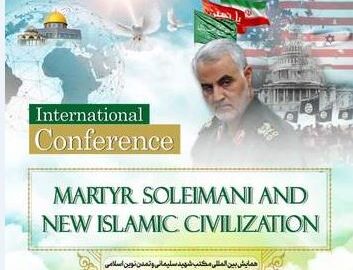
Call for articles on “International Conference of the School of Shahid Soleimani and the New Islamic Civilization”

The authentic Islamic teachings and the role of martyrs, elites and Muslim thinkers show that the personality of Prophet Mohammad, and imams (peace be upon them) are indicators of monotheism, freedom, peace, justice, security, and the preservation of human dignity in the path of divine civilization.

Concepts such as justice, security, and the pursuit of human well-being are great examples of humanity, and they are one of the important goals of the mission of the prophets, the righteous saints and the righteous martyrs, including the martyr Soleimani, in fighting against oppressive and tyrannical regimes in order to establish and consolidate peace and justice in the world, which is one of the lofty concepts of the school of Martyrs.

Therefore, the Islamic World Peace Forum, and considering its mission (showing and finding the path of the new Islamic civilization), and with the aim of analyzing the Martyr Soleimani School in this regard and with the basic belief that this school should be based on justice and human dignity and its great definition in the world for the sake of inspiration and freedom, it was decided to hold the third international conference of the Martyr Soleimani School and the new Islamic civilization.

And based on the holding of the first and second conferences and focusing on the role of the martyr Soleimani in developing security, justice and regional and global peace and welcoming the elites and different societies, considering the important conditions of the region and the world and the unique role of the martyr Hajj Qassem Soleimani in fighting against terrorism that everyone concessive, even the arrogant, and the need to talk about the school of that Martyr and its Effects To reach a new Islamic civilization, it was decided to hold an international conference with the title “The Martyr Soleimani School and the New Islamic Civilization.”

Axis of the Third International Conference of martyr Soleimani School and Modern Islamic Civilization

1. The role of Martyr Soleimani in building security, justice and peace in the region and the world
1-1- The idea of peace and justice in the view of the Leader of Islamic revolution Imam Khamenei and its impact on the thoughts of Martyr Soleimani
1-2- The role of Martyr Soleimani in establishing just peace and security in the West Asian region
1-3- Peace, justice and security in the school of martyr Soleimani
1-4- The role of Martyr Soleimani in promoting peace and security in the region and the Islamic world
1-5- Martyr Soleimani’s strategies for unity and interaction between Muslim nations and the region
1-6- The future of regional peace, justice and security research after Martyr Soleimani with a view to the second step of the revolution

2. Thought and management in the school of martyr Soleimani

2-1- Investigating the theoretical and managerial dimensions of Soleimani school
2-2- Indicators and managerial characteristics of martyr Soleimani
2-3- Explaining the thought, belief and management systems of martyr Soleimani school
2-4- Discourse-building and stream-making of martyr Soleimani school in the region
2-5- Martyr Soleimani School, a model for training civilized war commanders
2-6- Management of civilization level in Martyr Soleimani school
2-7- The thought of Martyr Soleimani and the elite society in the Islamic world
3. The new Islamic civilization and Martyr Soleimani
3-1- Spirituality and rationality; Important foundations of modern Islamic civilization in Soleimani school
3-2- Martyr Soleimani and the new revolutionary order of civilization in the region
3-3- The basic challenges of the new Islamic civilization from the perspective of Martyr Soleimani
3-4- The role and position of leadership in the desired society and modern Islamic civilization according to Martyr Soleimani
3-5- Characteristics and indicators of Islamic society in modern Islamic civilization from the perspective of Martyr Soleimani
4. Martyr Soleimani, the aspection of Palestine, the fight against terrorism and the discourse of resistance
4-1- Discourse of Resistance, Martyr Soleimani and Islamic Diplomacy
4-2- Discourse of Martyr Soleimani Resistance and West Asia
4-3- The role of martyr Soleimani in stabilizing the Palestinian cause
4-4- The civilization-building culture of resistance in the thought and action of Martyr Soleimani
4-5- The role of Martyr Soleimani in creating the spirit and will to fight terrorism
4-6- The role of Martyr Soleimani in promoting the deterrent power of the Resistance Front and the Islamic world
4-7- Martyr Soleimani and the globalization of the culture of resistance
Conference scheduling

Deadline for submitting abstracts: 26 December 2021

Deadline for submitting original articles: 10 January 2022

Date of the conference: 13 and 14 February 2022

Contact the conference secretariat:

Website: www.iwpeace.com and www.salamnews.ir

Email: [email protected]

Phone: +982188535248 Fax: +982188535247

Conference House Secretary: Tehran; Sohrevardi North St; Ibn Yamin St, Soroush St, Shahid Baqer Habibi Alley; No.14.

فراخوان انگلیسی مکتب شهید سل