All posts by islam

Iran’s exports to Russia rise 60%

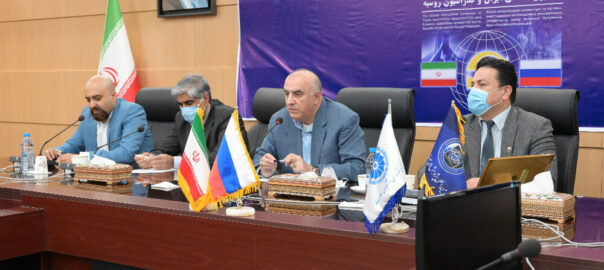
Iran’s exports to Russia have increased 60 percent since the beginning of the current Iranian calendar year (March 21, 2021) so far, the chairman of the Iran-Russia Joint Chamber of Commerce announced.

Hadi Tizhoosh Taban made the remarks in an Iran-Russia trade conference held at Tehran Permanent International Fairgrounds on Tuesday.

Organized by the International Institute of Iran Industries Research (MPSIran), the event was attended by senior officials from both sides including Tizhoosh Taban and the MPSIran Managing Director Sina Sanjari.

Speaking in the meeting, Tizhoosh Taban underlined the significance of holding mutual business conferences between the two countries, saying: “Holding such conferences will result in the discussion of various aspects of trade in other countries, especially in Russia, from different angles.”

He added that in order to develop foreign trade, a roadmap should be drawn, saying: “To develop exports, infrastructure such as logistics should be provided, this capacity exists on the border of Astrakhan with Iran, so since [the Iranian calendar year] 1396 (ended in March 2018), an Iranian trade center was founded in the city of Astrakhan.”

This center can provide the necessary ground for expanding economic relations between the two countries and strengthen the presence of Iranian exporters in Russia, Tizhoosh Taban said.

Further in the event, Sanjari, as the secretary of the conference, spoke about logistical, industrial, and political advantages of the two countries which have resulted in the growth of economic relations and the upward trend of mutual trade.

Elsewhere in the conference, Ahmad Asl Rokanabadi, an advisor to the Iranian Parliament, also announced the establishment of foreign trade centers in other countries and said that the parliament and the Trade Promotion Organization (TPO) have discussed and finalized the plan for establishing 195 trade centers in destination markets.

Referring to the development of petrochemical exports, Roknabadi said: “According to available statistics, Russia has raw materials for the production of petrochemical products, but its demand is always higher than production. Therefore, the country imports $30 billion worth of petrochemical products annually, and to make the most of this opportunity incentives should be provided for investors in this field.” /T.T/

Iranian short film to be screened at US Cinequest Film Fest.

Directed by Abbas Ghazali, the Iranian short film “Smile of the Mask” is scheduled to be screened at the US Cinequest Film Festival.

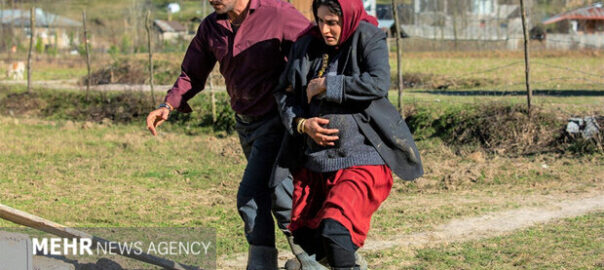
Being Ghazali’s third short film, Smile of the Mask is about the bitter social issue of acid spraying and the smiles hidden behind the victim’s masks.

The Cinequest Film & Creativity Festival is an annual independent film festival held each March in San Jose, California and Redwood City, California. The international festival combines the cinematic arts with Silicon Valley’s innovation. /MNA/

Iran marks National Day of Nasir al-Din Tusi

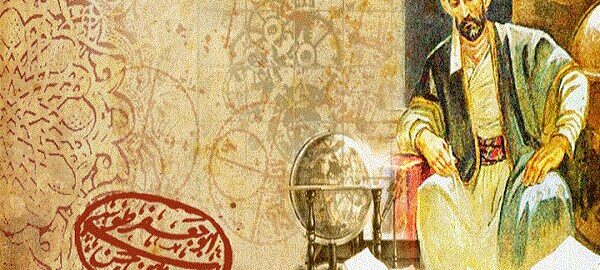
Today is the National Commemoration Day of the outstanding Iranian philosopher, scientist, and mathematician Nasir al-Din Tusi.

Tusi was born in Tus in 1201 and died in Baghdad in 1274. Very little is known about his childhood and early education, apart from what he writes in his autobiography, Contemplation and Action (Sayr wa suluk).

As a young boy, Nasir al-Din was encouraged by his father to study all “the branches of knowledge and to listen to the opinions of the followers of various sects and doctrines”; as such, Tusi travelled widely to study with teachers of his choice.

Tusi studied mathematics with Kamal al-Diin Hasib about whom we have no authentic knowledge. In Nishabur he met Farid al-Din ‘Attar, the legendary Sufi master who was later killed in the hand of Mongol invaders and attended the lectures of Qutb al-Din Misri and Farid al-Din Damad. In Mawsil he studied mathematics and astronomy with Kamal al-Din Yunus (d. 1242).

At the age of twenty-two or a while later, Tusi joined the court of Nasir al-Din Muhtashim, the Ismaili governor of Quhistan, Northeast Iran, where he was accepted into the Ismaili community as a novice.

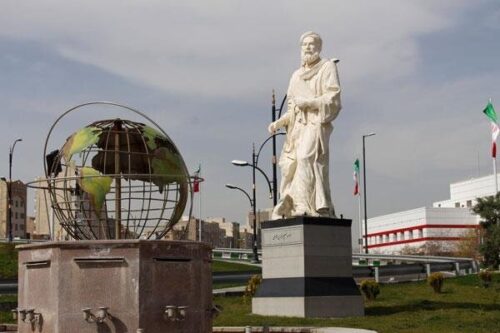
Nasir al-Din Tusi statue in Tabriz, East Azarbaijan, Iran

A sign of close personal relationship with Muhtashim’s family is to be seen in the dedication of a number of his scholarly works such as Akhlaq-i Nasiri and Akhlaq-i Muhtashimi to Nasir al-Din himself and Risala-yi Mu‘iniyya to his son Mu‘in al-Din.

Around 1236, he was in Alamut, the centre of Nizari Ismaili government. In Alamut, apart from teaching, editing, dictating and compiling scholarly works, Tusi climbed the ranks of the Ismaili da‘wat ascending to the position of chief missionary.

Through constant visits with scholars and tireless correspondence, Tusi kept his contact with the academic world outside Ismaili circles and was addressed as ‘the scholar’ from a very early period in his life.

The Mongol invasion and the turmoil it caused in the eastern Islamic territories hardly left the life of any of its citizens untouched. With the fall of Alamut in 1256 CE, Tusi became an advisor to the Mongol ruler Hulegu and was later made a wazir and placed in charge of waqf (religious endowments).

Among the major events of Tusi’s sojourn with the Mongols was the building of an observatory in Azerbaijan at Maragha under his direction, where the most renowned scientists of the time, including astronomers from China, participated in research and scientific observations. In 1274 CE, Tusi left Maragha with a group of his students for Baghdad, where he died in the same year.


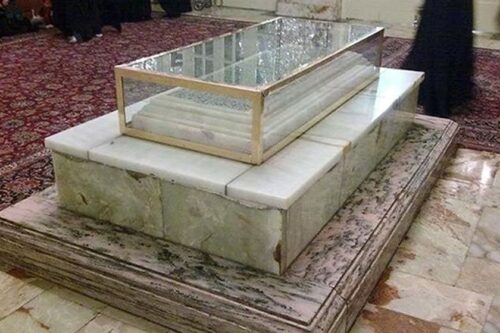
Tomb of Nasir al-Din al-Tusi in Kadhimiya, Iraq

Nasir al-Din al-Tusi’s contribution to the post-13th century intellectual history of Islam is monumental, and many of his works became the standard in a variety of disciplines up to modern times. Among his works on astronomy is al-Tadhkira fi ‘ilm al-hay’a (‘Memoir on the Science of Astronomy’), in which Tusi attempts to give a coherent and unified account of astronomy that would be useful both for students of the subject as well as non-specialists. The Tadhkira is modeled after one of Tusi’s Persian works, the Risalah-i Mu‘iniyya, which he wrote during the early period of his residence at the Ismaili stronghold in Quhistan.

The ensemble of Tusi’s writings amounts to approximately 165 titles on a wide variety of subjects. Some of them are simply a page or even half a page, but the majority with few exceptions, are well prepared scholarly works on astronomy, ethics, history, jurisprudence, logic, mathematics, medicine, philosophy, theology, poetry and the popular sciences. Tusi’s fame in his own lifetime guaranteed the survival of almost all of his scholarly output. The adverse effect of his fame is also the attribution of a number of works that neither match his style nor have the quality of his writings.

The 5th day of Esfand, the twelfth month on the Iranian calendar, which fell on February 24, has been designated as Engineer’s Day in Iran to commemorate Nasir al-Din Tusi, the most celebrated scholar of the 13th century. /MNA/

Iranian films line up for Bengaluru festival

Eight Iranian movies will be competing in the 13th Bengaluru International Film Festival opening on March 3 in the Indian city of Bengaluru.

“A Hero”, “180°Rule” and “Fathers” will be screened in the Cinema of the World category, while “Absence”, “Careless Crime”, “Killer Spider”, “The Alien” and “Two Dogs” will be showcased in the Asian Cinema competition.

“A Hero”, a co-production between Iran and France directed by two-time Oscar-winning director Asghar Farhadi, won the Grand Prix (ex aequo) at Cannes 2021.

It follows Rahim, who is in prison because he was unable to pay a debt. During a two-day leave of absence from prison, he attempts to have his creditor withdraw his complaint over part of the sum owed. But things don’t go as planned.

Directed by Farnush Samadi, “180°Rule” tells the story of a school teacher from Tehran, who is preparing to attend a wedding in northern Iran. When her husband suddenly forbids her to go, she makes a choice that will place her on a painful path to atonement.

“Fathers” by Salem Salavati depicts that the confrontation of two different generations can lead to some problems, however, the film shows that an incident brings two generations together.

“Absence” has been directed by Ali Mosaffa, producer of “180°Rule”.

The film is about an Iranian man who visits Prague to investigate his father’s youth in the city. He finds himself in the shoes of a third man who is almost dead and happens to be of Iranian origin. The film shows how the heavy security atmosphere coming after the 1953 military coup in Iran forced some to flee the country to seek asylum in Eastern Europe.

“Careless Crime”, winner of the Premio Bisato d’Oro for Best Original Screenplay at the Venice Film Festival, has been directed by Shahram Mokri.

It shows that protestors forty years ago, during the uprising to overthrow the Shah’s regime in Iran, set fire to movie theaters as a way of showing opposition to Western culture. Forty years have passed and, in contemporary Iran, four individuals also decide to burn down a cinema. Their intended target is a theater showing a film about an unearthed, unexploded missile.

Ebrahim Irajzad has directed “Killer Spider” based on a true story that occurred over ten years ago in the northeastern Iranian city of Mashhad.

Saeid is a forty-year-old mason, severe and fanatical in his religious beliefs. One day his wife is accosted by a driver who assumes she is a prostitute. Seething with rage, Saeid seeks revenge.

Directed by Nader Saeivar, “The Alien” follows two mysterious strangers in a car. They begin to park daily in an otherwise ordinary Iranian neighborhood and are suspected to be national security, which unleashes a wave of paranoia and distrust among the neighbors, as each one feels they have reasons to be watched. The neighbors collectively suspect, however, that the main target for the surveillance is Bakhtiar, a Kurdish teacher, a newcomer and a foreigner, and attempt to pressure him into giving himself up or leave the neighborhood.

“Two Dogs” directed by Amir Azizi is about Iman and Sajjad, two young men who are struggling with problems typical for 30-year-olds in contemporary Iran: unemployment, depression and lack of self-confidence. Iman is translating Franz Kafka’s “Investigations of a Dog” into Farsi and works as a cab driver, too. His passengers are similar to the characters of Kafka’s story. Sajjad, Iman’s best friend, is very inhibited because of the way he looks and is trying to obtain enough money for surgery. They both have dogs that look very similar to their owners. The dogs, not always welcomed by the families, make the men feel less lonely living in traditional Iranian society.

The Bengaluru International Film Festival will run until March 10. /T.T/

Iranian wrestlers win seven medals at Bulgarian event

Iranian Greco-Roman and freestyle wrestlers claimed seven medals at the Dan Kolov-Nikola Petrov International in Bulgaria.

Greco-Roman wrestlers Saeid Esmaeili and Meysam Dalkhani won two gold medals in 60kg and 63kg, respectively.

Alireza Abdevali in 72kg and Alireza Mehmedi in 82kg seized two bronze medals in the division.

Freestyler Meysam Abdi claimed Iran’s only silver in 97kg. Mostafa Ghiasi in 79kg and Yadollah Mohebi in 125kg also snatched two bronze medals in the competition.

The 59th edition of the event was held in Veliko Tarnovo, Bulgaria from Feb. 17 to 20.

This tournament was held in honor of Dan Kolov who was the first European freestyle wrestling champion from Bulgaria and European and world champion Nikola Petrov. /T.T/

Iran win CAVA Beach Volleyball Championship title

Iran defeated Sri Lanka to win the 1st Central Asian Volleyball Association (CAVA) Beach Volleyball Championship.

Iran 1’s Sina Shokati/ Mojtaba Aro beat Anjana/Sandun 2-0 (21-16,21-12) in the final match on Sunday.

Iran 2’s Mehdi Mahfoozi/ Ali Ghorbanpasandi won the bronze medal after their Sri Lankan opponents Tiron/Ashen withdrew from the match.

The three-day competition was held in Beach Park Negombo, Sri Lanka for the 75th Independence Cup. /T.T/

Shakerdoust wins award at Rabat Intl. Author Film Festival

Elnaz Shakerdoust won the Best Actress award at the Rabat International Author Film Festival for her role in the drama film “Titi”.

Shakerdoust won the award at the 26th edition of the Rabat International Author Film Festival held from February 11 to 19, 2022 in Morroco.

The jury members of the festival also praised the Iranian drama film “Titi” directed by Ida Panahandeh, for presenting a new theme and a different image of Iran.

The festival is dedicated to the Author cinema, a true cinema of art and thought in all its forms, to brave films, demanding, intelligent, even radicals who destroy the clichés; films that have an urgency and personal writing dedicated to humanity in all its forms./MNA/

7th Arbaeen Int’l Award Announces Winners

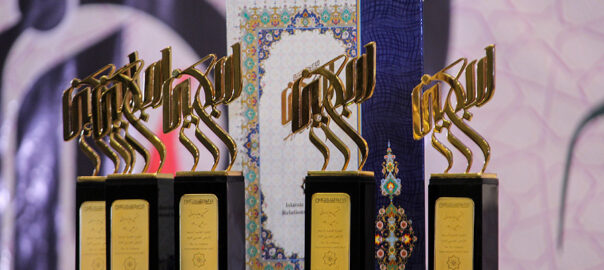
Winners of the 7th Arbaeen International Award were announced in the closing ceremony of the event on Wednesday.The ceremony was held in the headquarters of the Islamic Culture and Relations Organization, here in Tehran.

Amir Ali Javadian, a representative of the panel of arbiters said that a total of 4,800 works from 1,080 individuals in different categories of photography, films, books, etc. were received by the secretariat of the event.

In the photography category, Ahmad Abdul Amir from Iraq won the title, and Iran’s Hadi Dehghanpour and Arjan Arsalan from Turkey stood next.

Mohammad Faraj Salehi from Iran claimed the 1st rank of professional films and Iran’s Ruhollah Asadi Kiadehi was announced runner-up. Mohammad Azizi from Iran and Elchin Aghazada from the Republic of Azerbaijan stood next.

The category of popular films had no top winner but Zahra Lempan from Thailand and Ali Soltani from Iran gained second and third places.

In the category of travelogue, Maryam Ghandi from Iran, Abbas Karim Almohammadavi from Iraq, and Mohammad Etemadi from Afghanistan gained top three awards.

In the category of social media pages, Iraq’s Al-noreen Facebook page claimed the title while Ahlulbayttv page in Instagram from UK and Hoseiniee page in Instagram from Iran ranked next.

And finally, in the book category, Mohammadreza Abedini from Iran gained the top prize. Iran’s Mohammaderza Pouyafar and Serbia’s Serjan Markovich achieved the next ranks.

Responsibility for documenting Arbaeen
Addressing the event, head of the Islamic Culture and Relations Organization (ICOR) Hojat-ol-Islam Mohammad Mehdi Imanipour said that the closing ceremony was postponed due to the coronavirus pandemic restrictions.

Speaking about the March of Arbaeen, the cleric noted that the event paves the way for the formation of modern Islamic civilization as it attracts thousands of people who love Ahl al Bayt (AS).

He lauded the participation of people from 24 countries in this year’s edition of the international award despite the problems that were in place for traveling to Iraq during Arbaeen due to the pandemic.

Neutralizing enemies’ plans to distort the image of Iran in Iraq and vice versa, formation of moral virtues such as friendship, keeping the uprising of Imam Hussein (AS) alive, and showcasing the authority and power of Ahl al Bayt (AS) followers are among the features of the great March of Arbaeen, he said.

The fact that media affiliated to arrogant powers censor this popular event shows the influence of this movement, he said, noting, “This doubles our responsibility for documenting the Arbaeen.”

The poster of the 8th edition of the international award was also unveiled in the program:

ICRO has organized the Arabeen Award since 2014 with the aim of reflecting the manifestations of this international religious event to the world.

Wherever words cannot convey the greatness of a message, the best communication medium would be the language of art. That is why ICRO decided to hold the international award annually in the categories of photos, videos, and travelogues, with the aim of spreading the message of Arbaeen and Ashura.

Arbaeen, which is one of the largest religious gatherings in the world, comes 40 days after Ashura, the martyrdom anniversary of the third Shia Imam, Imam Hussein (AS).

Each year, a huge crowd of Shias flock to the Iraqi city of Karbala, where the holy shrine of Imam Hussein (AS) is located, to perform mourning rites. /IQNA/

Gilan exports $9.6m of handicrafts in year

Handicraft products worth $9.6 million were exported from the northern Gilan province during the current Iranian calendar year 1400 ( stared on March 21, 2021), the deputy provincial tourism chief has said.

The sum of handicraft exports has jumped fivefold since 1398 when the value of provincial handicrafts exports stood at $1.8 million, Farzad Rashidi said on Wednesday, IRNA reported.

“Despite sanctions and the outbreak of the coronavirus, Gilan’s handicraft exports reached $9.6 million this year which marks a significant growth compared to that of $1.8 million collected in the year 1398.”

The major share of this “success” is due to the registration of Qasemabad by the World Crafts Council as a global hub of handicrafts, the official explained.

“The WWC inscription has made the handicraft brand of Gilan province much more prominent and has provided a good ground for exports.”

Situated in Roodsar county, Qassemabad village is nationally known for its traditional costumes because of its vibrant colors and uniquely beautiful designs. However, the Chador Shab, a kind of homemade outer garment for women, was the main subject for the WCC assessment.

With 14 entries, Iran ranks first globally for the number of cities and villages registered by the World Crafts Council, as China with seven entries, Chile with four, and India with three ones come next.

The value of Iran’s handicrafts exports stood at $120 million during the first eleven months of the past Iranian calendar year 1399 (March 20, 2020 – February 18, 2021), Mehr reported. The country’s handicrafts exports slumped during the mentioned months in comparison to the same period last a year earlier due to the damage the coronavirus pandemic has inflicted on global trade.

The Islamic Republic exported $427 million worth of handicrafts during the first eleven months of the calendar year 1398. Of the figure, some $190 million was earned via suitcase trade (allowed for customs-free and tax-free transfer) through 20 provinces, according to data compiled by the Ministry of Cultural Heritage, Tourism and Handicrafts. Ceramics, pottery vessels, handwoven cloths as well as personal ornamentations with precious and semi-precious gemstones are traditionally exported to Iraq, Afghanistan, Germany, the U.S., the UK, and other countries. /T.T/

Close-up Film Festival spotlights Iranian short cinema

Six acclaimed Iranian shorts will be reviewed in a special program at the first edition of the Close-up Film Festival, which take place in March in Coquitlam, Canada.

“Are You Volleyball”, “Retouch”, “Lunch Time”, “Adamha” (“Human Beings”), “Cloudy Children” and “Animal” will be screened in the program “Focus on Iranian Short Films”, which will be organized in collaboration with the Coquitlam Public Library, City Centre Branch.

“Are You Volleyball” is about a group of Arab asylum seekers, who arrive at an English speaking country border and are prevented from continuing on. They have arguments with border guards every day until a deaf-mute boy becomes the catalyst for better communication between the two groups.

Directed by Mohammad Bakhshi, this film has been screened in numerous festivals across the globe and won several prizes, including the best short film award at the 9th BCN Sports Film Festival in Spain.

Winner of the Golden River and Audience Choice award at the 12th River Film Festival in Italy, “Retouch” has been directed Kaveh Mazaheri.

It follows a young woman whose husband is trapped under a halter during a workout, but she declines to save him and, consequently, he dies.

“Cloudy Children” directed by Reza Fahimi is another highlight of the lineup. Set in a central Iranian village, the film narrates the story of two students fighting over things that they could never have, and in the end they share everything that does not belong to them.

The movie emerged as the big winner at the Short Shorts Film Festival and Asia (SSFF & ASIA), receiving the Grand Prix of the event in Tokyo and Yokohama.

“Lunch Time” by Alireza Qasemi has also been won awards at several international film festivals.

The film is about a 16-year-old girl who is forced to deal with the harsh bureaucracy and the responsibility of identifying the body of her mother.

Each screening will be followed by a question and answer session, which will be attended by filmmakers and critics. /T.T/